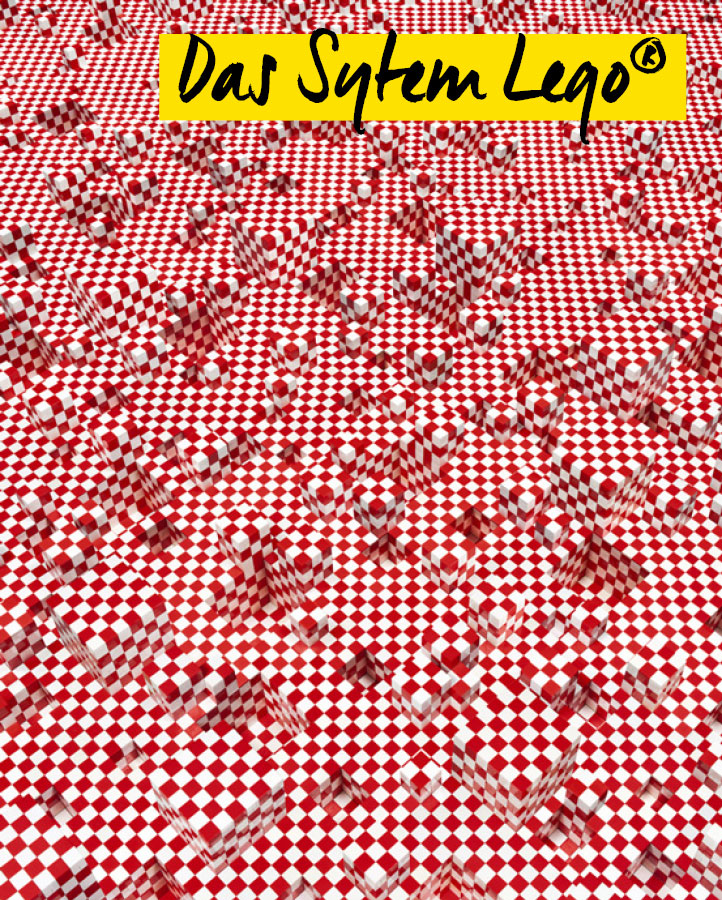

The Lego? System
From the magazine Schnappschuss No. 52
Andreas Zimmermann, photographer from D?sseldorf explains to us what stands behind his work, how he came to it and what it means to realize a conceptual photo project.
by Andreas Zimmermann
Many building blocks make a whole
My travels as a photographer give me the opportunity to visit many interesting places. I observe, photograph and collect. If something inspires me, I make photo notes or record what I have seen in drawings. Later, I often realize that the creative idea that was associated with it still exists and can flow into a current project. In this way, the new takes concrete form on the basis of the old, and a fund of spontaneous photographs, impressions and thoughts that has grown over the years provides me with the building blocks to create something that is self-sustaining once it is finished.
The Material
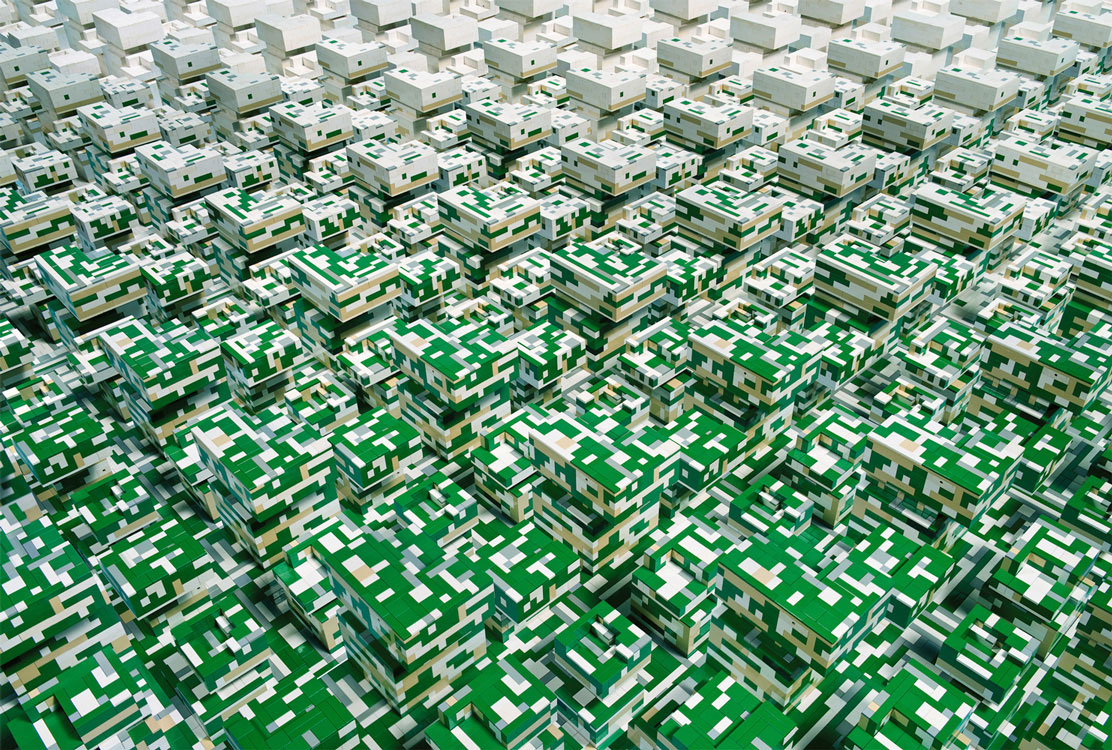
The material of the work is as clearly defined as it is uniformly structured. It is a collection of normal, rectangular Lego? bricks. In addition, there are building boards on which the arrangements are assembled and tiles that close off the shapes at the top.
upwards. The different sizes of the bricks and the plug-in connections allow a variety of possible shapes. Special bricks such as wheels and wing parts are not used in the work.
The System and its Openness
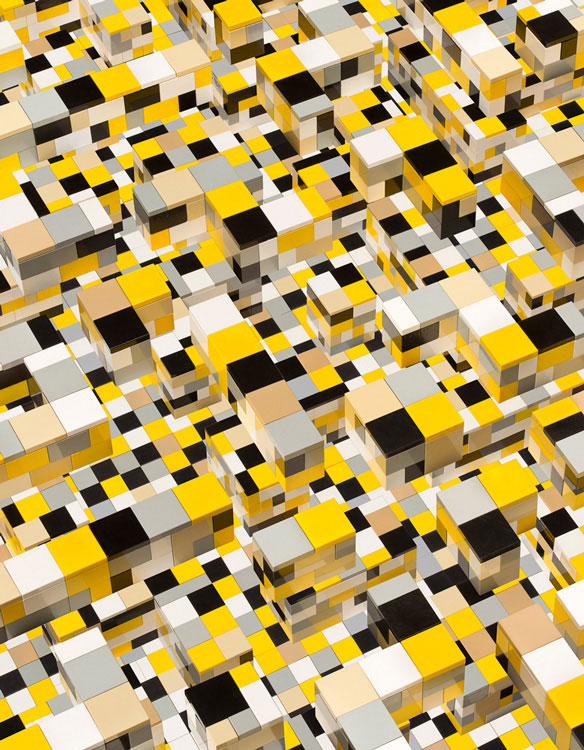
The material of the work brings its own conditions with it. The inherent system was accepted in the context of this work. All the formal elements that can be seen in the pictures are initially assembled manually at the work table. Forms can be freely invented or refer to - mostly architectural - models. It is a principle to follow a small rule for each work. One rule can be, for example, to only use white and black stones.
Once a set of rules has been established, the object is designed and realized on its basis. Anything the material can do is possible. The Lego? system is therefore open. The designed objects of the overall arrangement are photographed one after the other and always as new combinations of the same material. Each element has stood once in its assigned place, but at different times, so that individual bricks can be seen several times in the picture.
Authenticity
Some of the stones in the collections that provide the material for the present work have age-related or production-related characteristics such as scratches or yellowing. In this work, a mixture of used and new material is used to make the picture authentic and to emphasize with small details that it was not rendered on the computer. Just as there are imperfections and brushstrokes in painting that reveal the artist's working method, I leave small "mistakes" in my work so that the viewer has the opportunity to recognize the true origin of the image. I am interested in the moment of realization when the supposed computer image becomes a photographic image of the real world after closer examination.
Light and Shadow
In photography, light and shadow define the spatial relationship of objects as well as their relative size and central perspective. When viewing two-dimensional images, these spatial relationships are reconstructed in our brain. To make it more difficult for the viewer to
spatial decoding, I illuminate the objects as shadow-free as possible. The works are created exclusively under controlled conditions in the studio. I use several artificial light sources, such as electronic flash heads, with soft light shapers. The flat light allows the individual elements, which are complex and difficult to separate from each other, to flow together even more. Through cropping and collaging, the viewer is thus solely dependent on the linear perspective and the relative size of the objects in the pictures to decipher their spatiality.
Transfer problems
As in my artistic work, as a lecturer I am always concerned with the mechanisms of our perception in my discussions with students at the University of Wuppertal. The effort to reflect on the world around us inevitably results in transmission difficulties. How does an author influence his work in this process, how does he make use of the universally valid experiences of the laws of our environment in order to gain the viewer's understanding? Can art achieve this? If so, to what extent does it have to?
Camera setup and digital processing
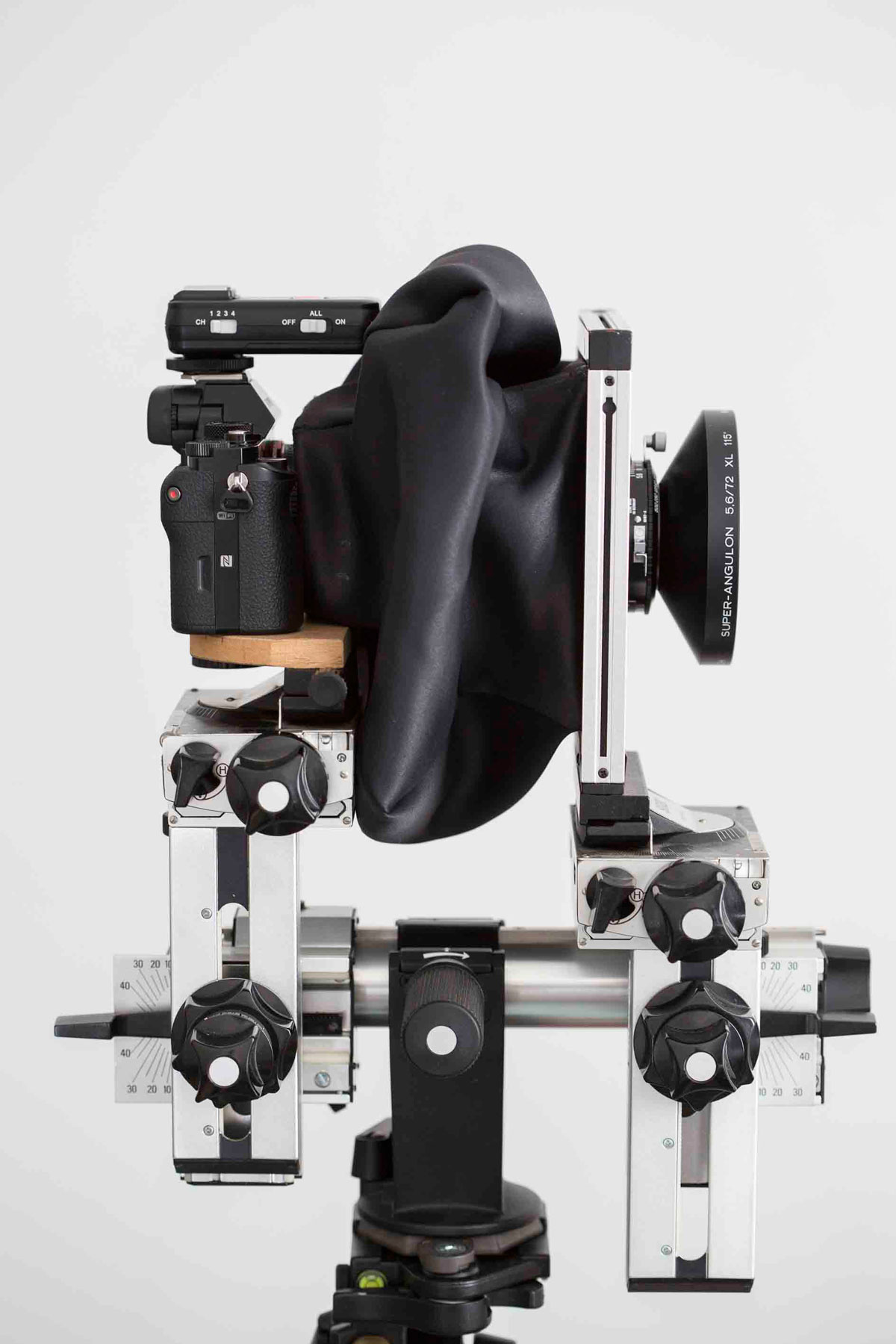
A combination of a view camera and a digital viewfinder camera is used for my work. A similar arrangement of the components lens, view camera and digital camera goes back to the Studiotool-Stm system by Finnish photographer Patrik Raski. Here, medium format lenses are combined with digital SLR cameras using adapters to achieve resolutions of over 100 million pixels. My current version consists of the combination of a mirrorless system camera, the Sony
Alpha 7R, a Sinar P and a 75 mm Schneider Kreuznach. The large image technology and its ability to shift makes digital stitching much easier. Stitching (also known as a function in smartphones and compact cameras) refers to a process in which an overall image is composed from many individual images - either to maximize the overall resolution of the image or because it cannot be captured in a single shot.
The latter aspect is particularly important in my work, as this technique enables me to build the individual constructions within a picture one after the other from the same stones, photograph them and thus free myself from the rigid space-time structure.
the rigid space-time structure. The high resolution is important in order to obtain works with a level of detail that preserves the smallest artifacts on the stones in the finished image. I sometimes only remove dust and adjust the colors in order to later put the individual photos together like a puzzle.
The possibility space Lego?
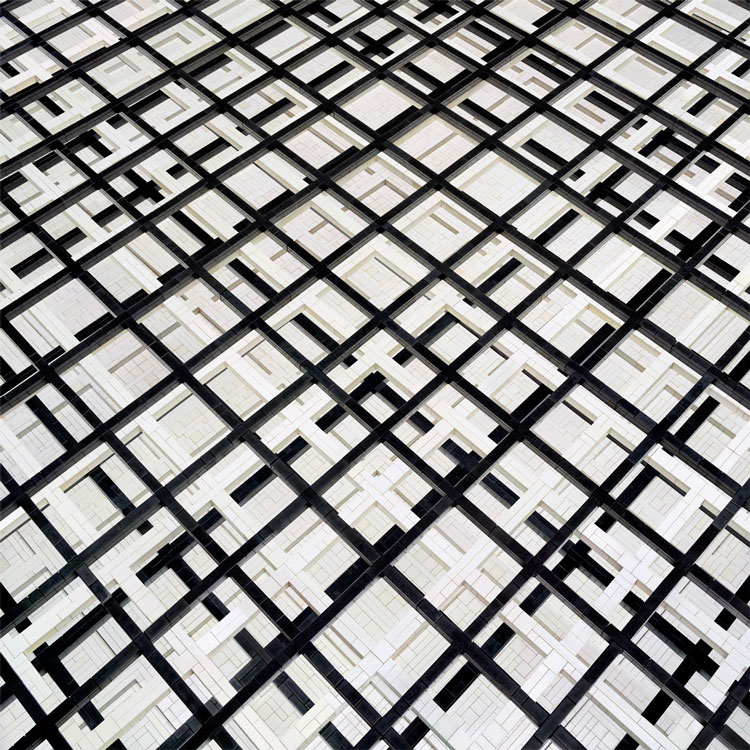
Lego? is a system for imitating reality, and I explore the space of possibilities that it opens up. The results of my work are large-format photographs that are reminiscent of abstract urban landscapes. However, although photographs of real buildings often serve as models, reconstruction is not the actual theme of the work. Rather, in dealing with the material - the templates, the building blocks, the constructions and motifs that are formed from them - the aim is to demonstrate that a formal rule automatically produces an aesthetic structure
provided that it is followed systematically. Such rules leave plenty of room for improvisation, yet it is precisely the systematic order that makes creative play with the found material possible in the first place. The system itself is ultimately a result of subjective (re)construction of reality and thus creates completely new, individual and variable contexts of meaning. The underlying
underlying construction principle is thereby obscured. The result is a kind of search image that invites the viewer to discover their very own system within the system.
Andreas Zimmermann was born in D?sseldorf in 1975. He studied photography at the University of Essen under Professor Bernhard Prinz and graduated in 2008 under Professor Gisela Bullacher and Professor Peter Wippermann. He lives and works in D?sseldorf. His work is represented by Galerie Lehr Zeitgen?ssische Kunst, Berlin. Since 2012 he has been teaching at the University of Wuppertal in the field of audiovisual media design and interactive media design, where he leads courses in photography and design.
Andreas Zimmermann, D?sseldorf
www.andreaszimmermann.net
Lehr Contemporary Art, Berlin
www.lehr-galerie.de

Magazine "Schnappschuss"
The Foto Koch magazine has a modern creative design and is relatively unique in terms of design and content.
further information