Frank Jurisch | The bokeh monster revisited - Sigma 85mm f/1.4
as part of our Online Fototage
The SIGMA 85mm F1.4 DG HSM is a Lens that has been impressing me for a few years now just by its sheer size. In this article, Frank Jurisch explains what has changed and why the SIGMA is the best choice for him.

 Frank Jurisch
The slightly better "best 85mm" in the world
You can almost see that this Lens has been uncompromisingly developed for imaging performance. SIGMA has thus achieved a real milestone. The unbelievable imaging performance up to 50 megapixels and high speed ensure sharp portraits and a dreamlike creamy focus that will make every bokeh lover rave. The fact that it has been dubbed the "new reference in its class" in many reviews is certainly justified, but for me there was never any question of buying it. What used to seem unimportant to me has now become very important to me due to the way I work in the studio, and that is the weight of a Lens. To be able to move freely, I need to be able to hold the camera with one hand at all times so that I can hold reflectors and lights with my free hand. As grandiose and imposing as the Lens is, it doesn't suit the way I work. But that should change in 2020...
 Frank Jurisch
The upgrades
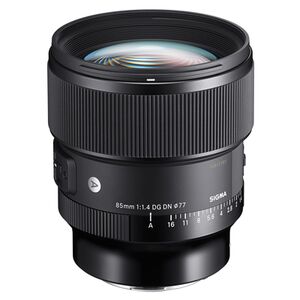
Here it is, the new SIGMA 85mm 1.4 DG DN. The announcement somehow surprised me, even if this step seems logical due to the ever-increasing spread of mirrorless systems. I really liked what was presented there. Developing a new Lens for the lower flange focal length of mirrorless systems certainly involves a lot of development work. As with the SIGMA 35mm F1.2 DG DN, I am very pleased that this step has been taken. If you compare the SIGMA 85mm 1.4 DG HSM with the new SIGMA 85mm 1.4 DG DN, one thing is very obvious: the size. The Lens has shrunk by 2cm in diameter and almost half the length, and weighs only half as much as its predecessor. This is a truly amazing result for such a fast Lens. The Lens is available for Sony E-mount and L-mount cameras.

85mm - more brilliant than ever before!
Axial chromatic aberrations are extremely well corrected in this Lens and are almost nowhere to be found in the photo. This is reflected in an incredible sharpness, even in fine, high-contrast details. The imaging performance is already so high at open aperture that I was always amazed when looking at the photos to see which aperture was used. With lenses for mirrorless systems, I have noticed that when the correction is deactivated by the camera, it is visible. I don't see correcting this digitally instead of laboriously in the lens as a disadvantage, I can always see a corrected image through the viewfinder, and if the imaging performance of the finished product is ultimately so outstandingly convincing, it only makes sense from a developer's point of view to use this effective option. I can only speculate as to whether this saved space or whether the new development to a low flange focal length significantly shrank the lens. It was probably a combination of both. The minimum distance at which focusing is possible should also be mentioned. At 85cm, this is at a good level for close-up photography.

Creamy bokeh - incredible sharpness
The features of the SIGMA 85mm F1.4 DG DN are also impressive. I think we have now reached the point where all user wishes have been realized. The most striking feature is the aperture ring, which allows the aperture to be selected directly on the Lens. This can also be set to "A" for automatic in order to continue to set the aperture via the camera. I was very impressed by the lock switch on the aperture ring, which is being used for the first time. This offers 2 possibilities to prevent accidental adjustment. If the aperture ring is set to automatic, the ring can no longer be turned. On the other hand, if you lock it to an aperture, the aperture ring can only be adjusted between f-stop 1.4 and 16. There is also a manual focus switch on the Lens, which has long been a standard feature of the Art series. It is joined by a freely assignable button, which I like to use to switch between left and right eye detection. There is also a switch to deactivate the click function of the aperture ring, which is sure to delight many videographers. As with the SIGMA 35mm F1.2 DG DN, the lens hood has a lock button to prevent it from twisting. As usual from SIGMA, a high-quality bag for storage and transportation is also included in the scope of delivery.
The photos taken with Lea were taken with a Sony full-frame and crop camera in order to test the Lens extensively. On both systems, the SIGMA 85mm F1.4 DG DN performed excellently in terms of imaging performance, autofocus speed and accuracy. In the end, my favorite pictures shown here were all taken with the crop camera. Based on the fact that this Lens is intended to appeal to portrait photographers in particular, the concept has worked out perfectly.
A compact, extremely fast Lens, with creamy bokeh and a grandiose sharpness already at open aperture. Lots of great and useful features at an unbeatable price-performance ratio. A Lens to fall in love with.