Our first review of the Panasonic Lumix G9II
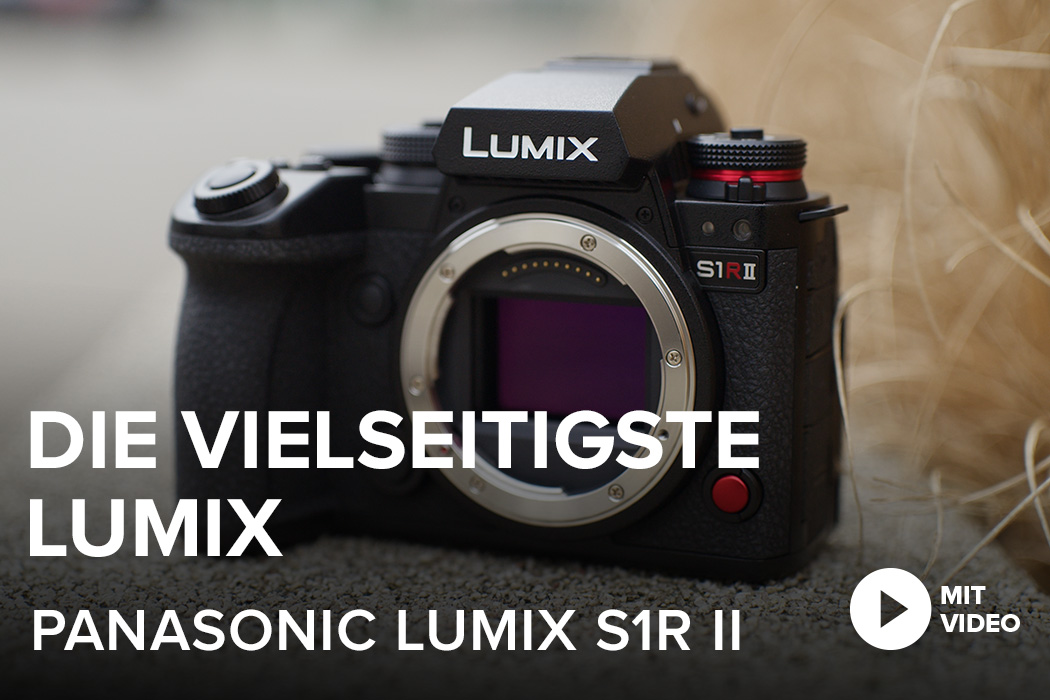
This year there's simply a reason for Panasonic fans to celebrate, as their system cameras have been around for 15 years and they're celebrating with a new Lumix G9II. This camera is a welcome successor to the G9 and you'll find out why in the article below. But in the end, we have a few more novelties and news.
Table of Contents
The new G9 body and its form factor
The new 25 Megapixel MFT sensor
The speed of the Lumix G9II
The new autofocus of the G9 II
The supporting titan: The image stabilization
The video quality
Photo +& video real-time LUTs
New lenses from Panasonic for MFT
The L-Alliance moves forward with determination
Conclusion

The new G9 body and its form factor
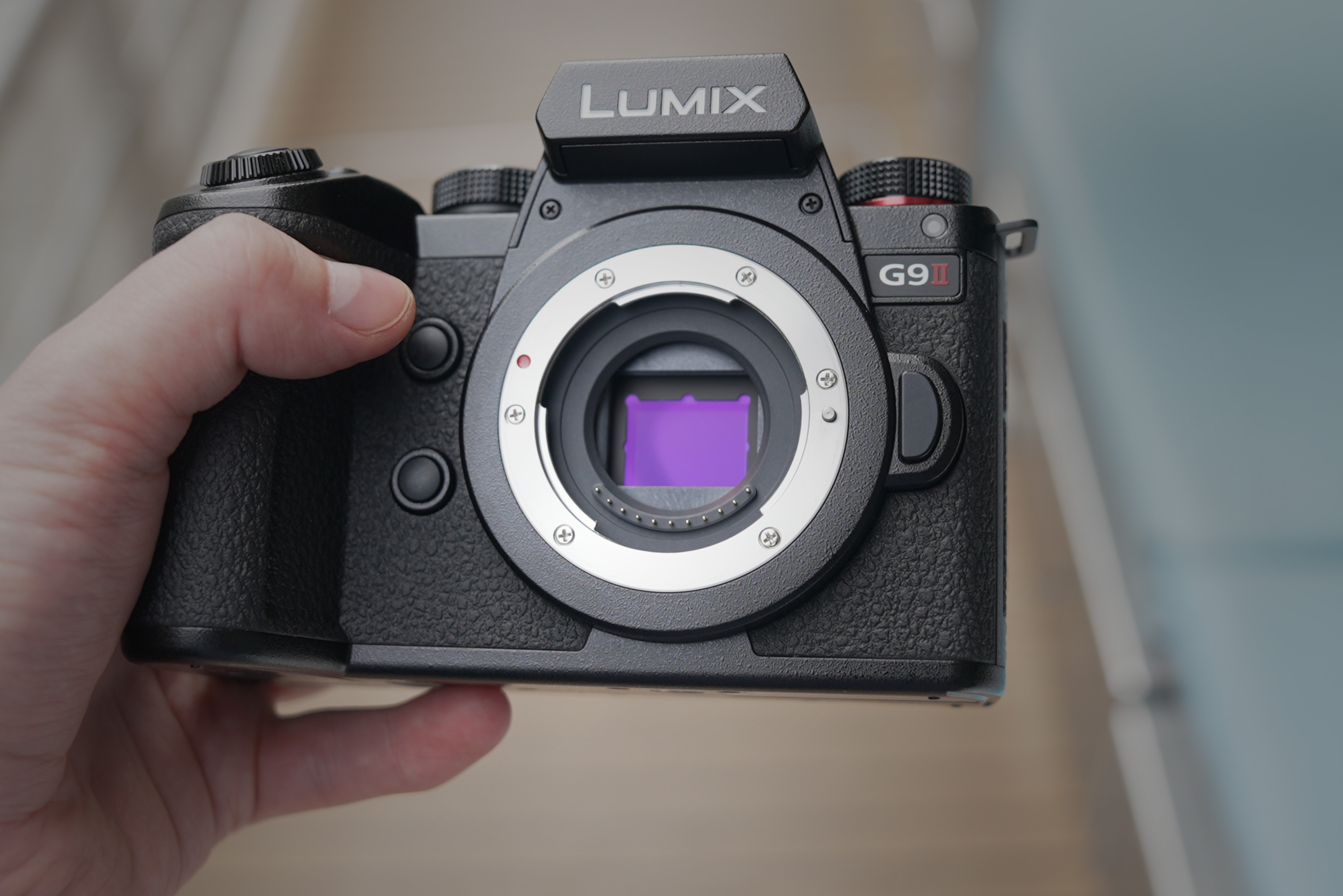
The G9 Mark 1 enjoyed a great deal of popularity as an MFT camera. Its weight and size made it the perfect camera for travel bags and more for most photographers. Its successor, the Lumix G9II, is now in the body of the Lumix S5II, which of course means that the camera is larger, but it essentially has advantages that benefit the camera.
The components of the S5II in the G9II
So the G9 II has inherited the following components from the S5 II:
- same viewfinder
- same display
- same connectors
- same button layout


This has many advantages: Especially if you work with several cameras at the same time and have to switch between them quickly, then you can get to all the setting options without having to get used to them and you are also used to the same image quality of the viewfinder / display. A not to be neglected advantage is of course also given by the same connections, because you need the same cables and so you can either save cables or, albeit blindly, reach into your pocket and the cables are compatible with all cameras, which is also very helpful in stressful situations.
Also feel free to read or check out our review / introduction of the Panasonic Lumix S5 II, which we published in the past.
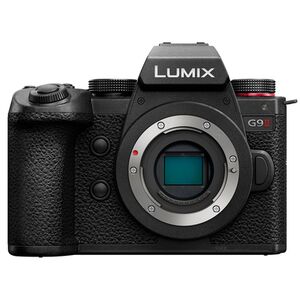
Panasonic Lumix DC-G9 II Micro Four Thirds
- high image quality â new 25,2 MP sensor + new processor / 100 MP HighRes handheld recording
- Dynamic Range Boost for still images
- Active I.S. technology
- best image stabilizer â 8.0 levels housing stabilizer / 7.5 levels dual image stabilizer
- high AF speed â Phase Hybrid AF (779 phase detection points)
- High-speed continuous shooting â electric shutter AFS 75fps / AFC 60fps; mechan. Shutter AFS 14fps / AFC 10fps
- professional video recording â up to 4K 120p / 6K 30p (Opengate 3:2; Full sensor readout) / slow motion Full-HD up to 300p
- robust design â magnesium housing, cold/dust + splash water protection
- intuitive operation â 8-direction joystick, large OLED viewfinder, free swivel LCD, 2 SD card slots
Form factor comparison of the two G9I to the G9II
While the new Panasonic G9II is now larger than the G9 Mark I, it weighs 658g, which is still quite light for a camera and still feels good in the hand with large telephoto lenses. But we're still talking about a Micro Four Third camera here, where the optics are usually half the weight of a comparable full-frame lens, even at long focal lengths. The shoulder display, which was still installed in the G9I, has been omitted from the G9II.
The optional battery grip
The new battery grip of the G9II is not only compatible with the G9I, but also with the Lumix S5II and Lumix S5IIx, which is not really surprising due to the identical housing. It offers space for two batteries and access to the most important function buttons. However, most will appreciate it just for the better grip and the possibility for high-form shots.

Panasonic DMW-BG1E battery grip

The new 25 megapixel MFT sensor
The new sensor of the G9II not only trumps with 5 megapixels more than the predecessor, but above all offers an improved resolution and a significant improvement of the dynamic range. Panasonic has reverted to a tried and tested sensor and used the sensor from the GH6. However, the G9II has not inherited the autofocus system. We'll get to that later, though.
The sensor is supported by the latest generation of Panasonic's processor unit, which can process images twice as fast as it was possible with the old processor, which has a positive effect on the continuous shooting speed and video quality.
Prejudices about Micro Four Third cameras
We know it from ourselves and who doesn't know it, the negative prejudices attributed to the MFT system? But why MFT sensors have their justification, we want to name of course also once. For example, the MFT sensor with its crop factor achieves twice the focal length on paper compared to the full-frame sensor. This is especially interesting when you are out and about in sports photography or wildlife photography and are dependent on long focal lengths. But that's not all: The sensor format is also perfect for social media use, since you can crop the images well in landscape and portrait format.
But that's not even the Micro Four Third System's greatest strength, because that lies in the sensor's image stabilization. This is because the smaller and lighter sensor can simply be held in position better than a full-frame sensor does. We will come back to this in more detail.
The speed of the Lumix G9II
This is where the new processor comes into its own, with the camera managing a full 65 frames per second in AF-C and even 75 frames per second in AF-S with the electric shutter. If you only compare the data sheets here, that's not really a difference of just 5 frames per second, but we'd say it's not comparable. Because the G9 Mark I was recording 60fps 4K video at this moment, extracting 8 megapixel JPEGs.
But with the G9II, we're talking JPEGs and RAW shooting, which means something like a change from 20 (G9I) to 65 frames per second in AF-C. The thing Panasonic is also including in the G9II that some manufacturers don't is the Pre-Burst function, this was already something the G9 Mark 1 could do with the half shutter depressed, here 0.4 seconds before the shutter button was pressed let the continuous shooting be buffered so you never miss a moment again! But now, with the MK2 of the G9 we can 0.5s, 1s or even 1.5 seconds before the actual shutter release and that at full continuous shooting speed.
So in AF-C, the G9 II manages to save just under 100 images before we pressed the shutter button. This gives us a nice flipbook to look at afterwards and find the right moment.
The new autofocus of the G9 II
But even the fast continuous shooting speed doesn't do you any good if the autofocus supports this performance. Panasonic is backing the right horse here, with the new generation autofocus that found its way into the Lumix DC-S5II +& DC-S5IIx, which we already praised in our review.
The G9 I still had a contrast aut ofocus installed, which made it quite sluggish, and the Mark II now puts that in the shade, with a hybrid autofocus and advanced scene detection. In addition to people, animals, birds, vehicles, planes and trains are also detected and tracked. This will certainly please every Panasonic MFT user, because the subjects in nature like to move a little faster. That's where the new autofocus has a positive effect for photography and videography.
In low light or situations where the light is poor, the autofocus keeps its performance at up to -6 EV, here the autofocus of the G9I already had a pretty good performance of up to -4 EV in the past.
The supporting titan: Image stabilization
The headline suggests a lot and we were not disappointed, feel free to check out the video to see for yourself visually. No matter what we tested on the camera, nothing was as impressive as the handheld image stabilization. Up to 8 exposure levels can be corrected here by the camera and lens together. Okay, with the G9 Mark 1 this was "only" 6.5 exposure stops. If you can't do much with that, you should definitely take a look at our video, because there you'll see a very practical example.
In any case, this strong image stabilizer makes it possible to shoot very well handheld without the shot looking blurry. This is also where the new improved gyro sensor comes in, which is installed under the viewfinder. It measures every movement of the camera in great or rather extreme detail and passes this on to the built-in IBIS and the additional software features like the digital image stabilization algorithm. Thus, this image stabilization manages to save image material that otherwise would not have been usable.
Last but not least, the stabilizer allows up to 100 megapixel high-res shots in RAW and Jpeg handheld, for which it shifts the sensor. The feature is not new and was already built into the GH-6; and in its predecessor, these shots were only available from the tripod at up to 80 megapixels.
Are we at the end? No, not by a long shot! Because now we will move on to the video aspects of the Panasonic Lumix G9 Mark II.

The video quality
Looking at the data now, the Lumix G9 II is the better Panasonic Lumix GH-6, because it has everything you want and leaves almost nothing to be desired. 4K 60p 4:2:2 10 bit, 4K 120p 4:2:0 10 bit up to Cine 4K everything is usable, there beats the videographer heart much higher! But hey, we don't stop there, now nerds should buckle up once again, because it also supports 5.8K Open Gate. In doing so, the camera is able to read the entire sensor and maintain the aspect ratio of the sensor and that's special! Because normally the sensor is cropped to 16:9 when recording, instead of reading out the sensor completely. There can be several reasons for this. Reasons include processor performance or the write speed of the card connector.
Open Gate allows you to crop the video for horizontal or vertical afterwards, of course this changes the whole scene and the mood, but you can use the video on different platforms. For example, the clip can be used as 16:9 vertical, horizontal or 1:1, or even as a 5:4 crop, depending on the requirements. So Panasonic now also has the more suitable 4:3 to offer and not just the 2:3 aspect ratio of the S5 II series.
Last but not least, the G9 II also offers external SSD support via USB-C, which is just awesome, because SSDs are also simply cheaper than most fast SD cards and offer the possibility of even more storage for longer recording times for the price of fast memory cards.
Photo +& Video real time LUTs
We found the use of LUTs already in the Panasonic S5ii and S5IIx, that allows to apply a color look to the video already in the camera. For all those who don't know what a LUT is, we'll give you an explanation: A LUT (Look Up Table) is a reference table of brightnesses and colors, with which you can play with the colors and the exposure of a picture. For example, you can change a blue to a cyan in the camera or change the luminance so that the sky looks much more intense.
It is possible that the camera already saves the images with the look, but it also allows on top to save them as RAWs. This has the advantage that contrary to a photo look that your camera has, you can put any look on your camera, you can even look at Panasonic itself:
The best part is that these LUTs can also be customized somewhat in-camera to fit your current situation.

New lenses from Panasonic for MFT
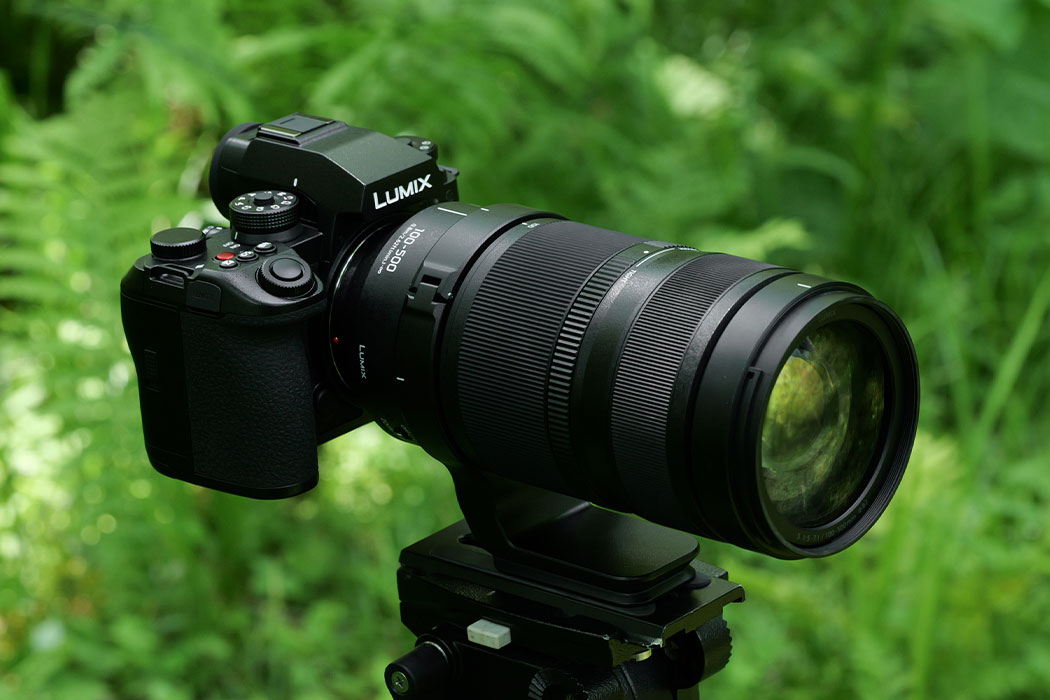
Well, as if this camera wasn't enough for one day, we have one more to add to the list: the new edition of the 100-400mm, which is equivalent to a focal length of 200-800mm. So this list is also still compatible with a 2x teleconverter and thus offers 400-1600mm calculated on 35mm. Now you should hold on once again, the closest focusing distance then still allows you to have a 1:1 macro at 1600mm. So if you haven't thought about a MFT camera as a wildlife photographer yet, you have every reason to think about it now.

Panasonic Leica DG Vario-Elmar 100-400mm f/4.0-6.3 II ASPH. / POWER O.I.S. Micro Four Thirds
- fast 4.0 to 6.3 lens of highest quality
- Focal length 400 mm (KB: 800 mm), with tele-converter* max. 800 mm (KB: 1,600 mm)
- optical image stabilizer â Sharp photos even at slow shutter speeds; Dual IS compatible
- Lens construction includes 20 elements in 13 groups (1 ASPH. ED, 1 UED, 2 ED)
- minimum focus distance of 1.3 m (limit: 5m) / magnification factor 0.25x (equivalent KB: 0.5x)
- robust design thanks to dust-, splash- and cold-resistant housing
- compact and lightweight â only 17.2 cm long and 985 g light
The second "new" lens: 35-100mm f2.8
Panasonic has revised its 35-100mm f/2.8, adapted the coatings to the Leica standards and further improved the built-in glass.
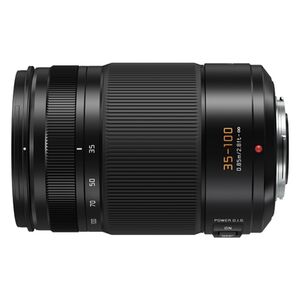
Panasonic Leica DG Vario-Emarit AF 35-100mm f/2.8 Micro Four Thirds
- continuous light output â aperture F2.8 over the entire range
- optical image stabilizer â Sharp photos even at slower shutter speeds; Dual IS compatible
- Lens construction â 18 elements in 13 groups (1 UED, 2 ED)
- minimum focus distance â 85 cm / magnification factor 0.1x (KB: 0.2x)
- robust design â dust, splash and cold resistant
- compact and lightweight â only 10 cm long and 360 g light
The L Alliance moves forward with determination
By now, the L Alliance includes 7 manufacturers and maybe most people didn't realize it, but DJI is also on board. This alliance is once again bearing fruit as DJI and Panasonic have teamed up and announced two new features that could change things up quite a bit. If you're interested, be sure to follow us on Youtube.
Conclusion
The Panasonic brand is celebrating its comeback on every level. Whether in full-frame with the S5II or its sister the S5IIx, but also with the now presented Lumix G9 for MFT photographers.
We couldn't let it go and have also scheduled a livestream for you on Youtube on 09/15. Jakob our Lumix G9 photographer for the livestream also says that this camera is a gamechanger for him and his work. The less baggage he needs, the better it is for him, in this case the image stabilizer, which replaces his tripod more and more.
The final thing to say about G9II is that the important innovations Panasonic introduced in the S5 II are finally finding their way into the G system. We are simply excited about everything that is still to come in the near future, because the right steps have been taken.