
69 | 100 Cosmic Vagabond
 Eugen Kamenev
from the series 100 photos - 100 stories
Foto Koch celebrates 100 years and we tell YOUR best stories, because without you we wouldn't be here. Today's story comes from Eugen Kamenev and he tells us how significant the photograph of comet Neovise was for him and what an incredible natural phenomenon it is!
In the early hours of the morning, on the way to kindergarten, my father showed me the constellation of the Great Bear. It was here, in the Kazakh steppe, that my interest in astronomy was sparked. For my birthday, when I was 12 years old, my mother gave me an analog camera. The result was a kind of symbiosis between astronomy and photography, astrophotography. In 1997, a large comet appeared in the night sky. Two independent amateur astronomers, Alan Hale and Thomas Bopp, discovered a comet named after their surnames. Hale-Bopp was the first comet I was able to admire with the naked eye. It was visible for over 18 months. I bought a telescope especially to be able to see it better. As a 15-year-old, I couldn't have imagined that I would have to wait 23 years for the next big comet. I've regretted not photographing Hale-Bopp all these years. Instead, I tried to film this cosmic vagabond with an analog cassette camera. My analog video camera was not light sensitive enough to capture the beauty of this unforgettable celestial phenomenon. I swore to myself that if I had the chance to experience a large comet again, I would definitely capture it photographically.
Neowise
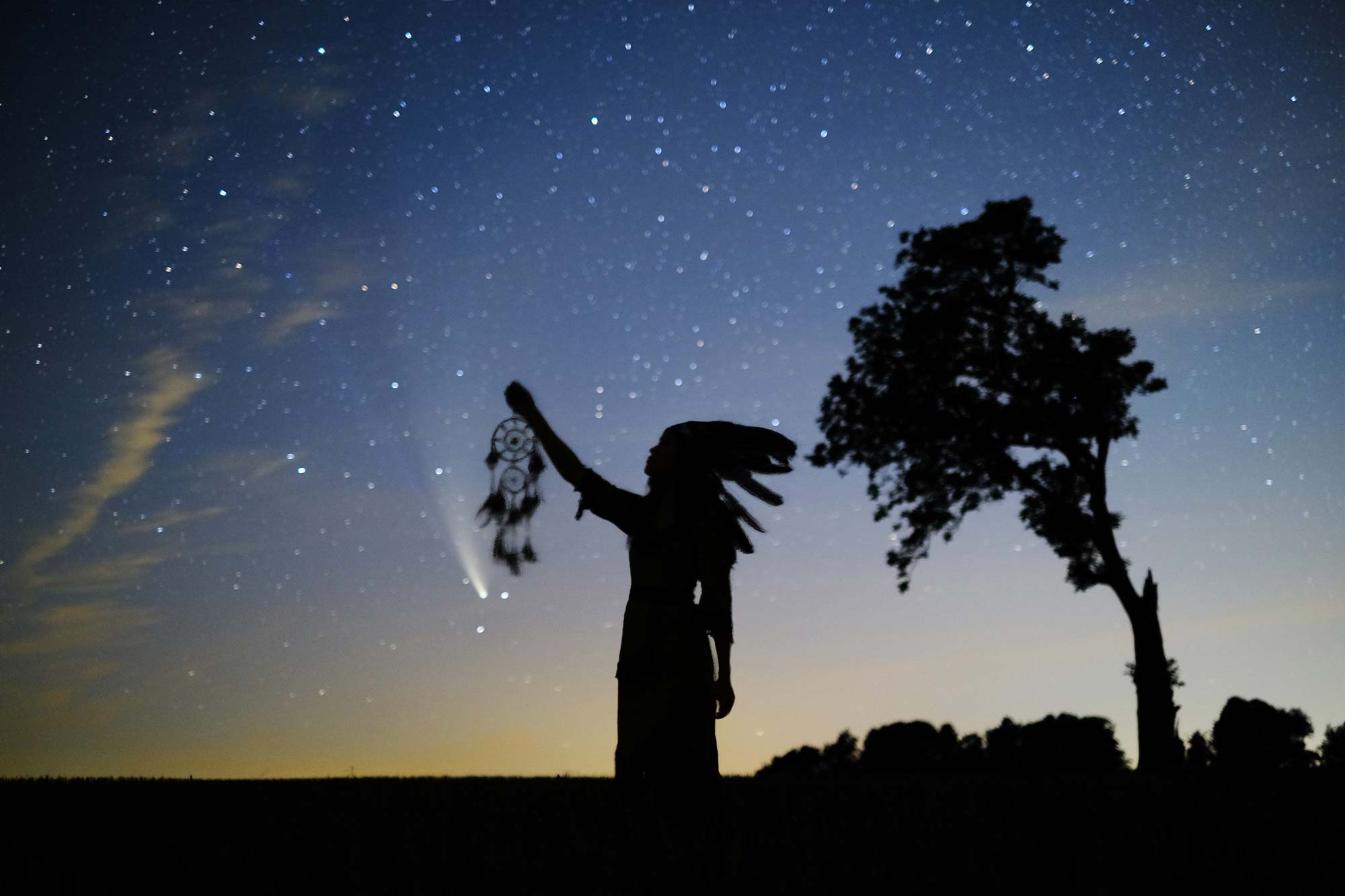
As an official Fujifilm X-Photographer, I no longer have any analog equipment at my disposal, but several digital Fujifilm system cameras. I was already doubting whether a big comet would appear in my lifetime. Then the surprise comet NEOWISE appeared. It was discovered on March 27, 2020 with the WISE space telescope. The comet was given its name as part of the NEOWISE (Near-Earth Object Wide-field Infrared Survey Explorer) project. In the past, before the digital age, comets bore the surnames of their discoverers. Today, it is almost impossible for an amateur astronomer to be the first to find a new comet, as automated telescopes digitally scan the night sky for new comets and asteroids. David H. Levy discovered a total of 22 comets alone and in collaboration with the legendary Eugene Shoemaker. The two became world-famous with the discovery of the Shoemaker-Levy 9 comet, which collided with the planet Jupiter in July 1994. NEOWISE passed Earth on July 23, 2020 at a safe distance of 103 million km. It was precisely at this time that I saw the unique opportunity to portray NEOWISE. This celestial messenger seemed so surreal to me that if I hadn't captured it photographically, I would have thought it was just a dream. Two tails were visible. A transparent curved dust tail and a bluish ion tail are clearly visible in the photographs.
2061
The cosmic vagabond NEOWISE visited us back in 2518 BC. In midsummer 2020, this comet put on a spectacular celestial show. On the astronomical scale, our existence on Earth is just the blink of an eye. In the year 8942, NEOWISE will visit our solar system again. I am glad that I have had the privilege of experiencing two large comets in my lifetime and, at the age of 38, to document the second comet photographically. Let's hope I don't have to wait until July 28, 2061 for Halley's Comet. I hope that I will be able to experience at least one other major comet before my 79th birthday. At FOTOKOCH, Eugen Kamenew offers photographic trips to the aurora borealis in Swedish Lapland.
He is also a lecturer at the FOTOKOCH Academy and offers a wide range of photo workshops, from beginners' courses to themed workshops. You can also find more of his work on Facebook, Instagram and YouTube.