Fujifilm X-T4 vs X-T3 | Comparison of the X-series top models
Fujifilm has launched the X-T4 as the successor to the X-T3! The new flagship of the Fujifilm X-series should bring improvements, particularly in the area of âvideoâ. The X-T3 - which was presented at Photokina 2018 - already set new standards in terms of speed and video performance. With the X-T4, Fujifilm has gone one step further, making it interesting for professional videographers and vloggers too. In this blog post, you can find out where the differences lie compared to the previous model and whether an upgrade is really worthwhile.
We look forward to your feedback on this post! Simply send us an e-mail to content@fotokoch.de


1. Size and handling of the X-T4
The camera body has become slightly larger, making the camera heavier. This provides space for the new battery, which Fujifilm has adapted for the X-T4, as well as the first sensor stabilization in Fujifilm X-T series cameras. In addition, the hand grip has become larger, making the camera easier to hold when shooting and filming. Small changes have also been made to the arrangement of the buttons, allowing you to switch more quickly between settings and between photo and video. Take a look at our YouTube video, where we explain the new button layout.
2. Sensor and IBIS of the X-T4
One of the biggest and most important differences of the X-T4 is the integrated 5-axis stabilizer! With the exception of the X-H1, this has never been built into a Fujifilm X system camera before. An integrated sensor stabilization has the great advantage that you no longer have to rely on the stabilization in the lenses. If the lens used is also stabilized, the two image stabilizers complement each other automatically.
With the help of IBIS (in body image stabilization), longer exposure times and difficult hand-held shots can be achieved. Sensor-stabilized cameras also offer considerable advantages for video recording. It is possible to take hand-held shots with little blurring, which can make work much easier. The image stabilizer itself is smaller than on the Fujfiilm X-H1, but the compensation performance of the X-T4 is up to 6.5 f-stops (on average 1.5 f-stops more than on the X-H1).
Theautofocus hardware has been carried over from the previous model, but the AF algorithm and phase detection have been adapted, which has significantly improved the focus performance. The face and eye autofocus has also been revised and improved, which is a particular advantage when filming. It should be mentioned that our model is a pre-production model and there may be some deviations. You can see a comparison video in the video test.

3. Display of the X-T4
The size of the touch LCD display has remained the same, but the resolution has been increased from 1.04 million pixels to 1.62 million pixels. The display of the X-T3 can be swiveled and tilted, which has now been replaced in the X-T4 by a completely swiveling and rotatable display. This makes Fujifilm particularly appealing to videographers and vloggers, as it allows them to easily check the settings and exposure without much assistance. This is also an advantage when transporting the camera, as it protects the display from dust and other external factors.
4. Video recording with the X-T4
In addition to the integrated and improved image stabilizer, Fujifilm has also improved the performance of video recording and thus represents a further step forward compared to the X-T3.
With both system cameras it is possible to record in 4K at 24 to 60 frames per second, with a crop factor of 1.18x.
Improvements have been made to the X-T4 with regard to high-speed slow motion recording in FullHD. While the X-T3 "only" manages 120 full frames per second and a maximum of 5x slow motion, the X-T4 achieves up to 240 full frames per second and 10x slow motion (with a crop factor of 1.29x).
This is a huge improvement and a big advantage over other system cameras in its class. This makes the X-T4 unique in its class. The sound is recorded by the integrated stereo microphone, for improved quality an external microphone can also be connected via the jack input.
Unfortunately, the X-T4 does not have a headphone output, this can only be connected with a USB-C adapter. However, if you want to charge the camera and use the headphone output at the same time, there is an additional battery grip that is also equipped with a headphone output.
5. Battery, memory card and co.
By adjusting the size, there is now also space for a new battery in the X-T4. The new battery is the "NP-W235" model. The capacity has been increased from 1,200 mAh to 2,200 mAh, so that more photos and longer film recordings can be achieved. (110 minutes instead of 40 minutes).
Changes have also been made to the memory card slot. This has been slightly enlarged and the two memory card inputs (both UHS-II) are arranged one above the other on the X-T4.
6. That has remained the same:
- 26.1MP APS-C CMOS sensor
- X-Processor
- ISO 160 to 12800, Extended from 80 to 51200
- 4K video recording up to 60p, F-Log, HLG, Eterna profile
- Up to 30 frames per second with the electronic shutter
- 1/8000s (mechanical shutter) and 1/32000s (electronic shutter)
- Electronic viewfinder with 3.68M dots and 100fps refresh rate
- Dust and splash water protection
- Two SD card slots (UHS-II)
- WiFi and Bluetooth
- USB-C connection with charging and power supply
To summarize, with the X-T4 Fujifilm has brought out a model that offers great advantages, especially for videographers. The integrated and improved image stabilizer and the new autofocus system, as well as the swivel and rotatable display make the camera particularly attractive. Fujifilm's high-speed slow-motion recording in particular sets it apart and offers an unprecedented advantage over other system cameras. Compared to the predecessor model, there are several advantages that speak in favor of switching to the X-T4. In terms of image quality, we can rely on the same results as from the X-T3. Fujifilm offers an affordable alternative to full-frame system cameras in the APS-C range, with which you can achieve equally high-quality results.
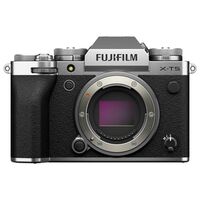
Fujifilm X-T5 - successor to the X-T 4 + 5
- 40 megapixel X-Trans CMOS 5HR sensor
- Viewfinder 0.8x, 3.69 million dots
- 100 fps blackout-free EVF
- 6.2K/30P, 4K/60P video recording
- Face/eye and scene recognition
- improved focusing accuracy for fine textures