Lenses by type



Free live consultation
Your individual consultation - from the comfort of your sofa
Arrange appointment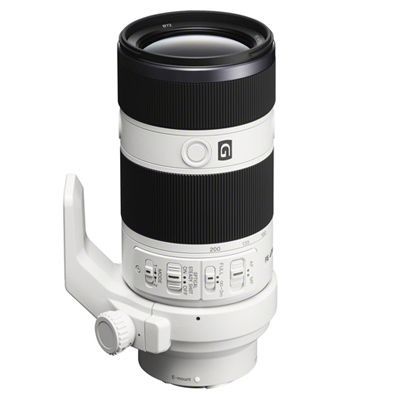
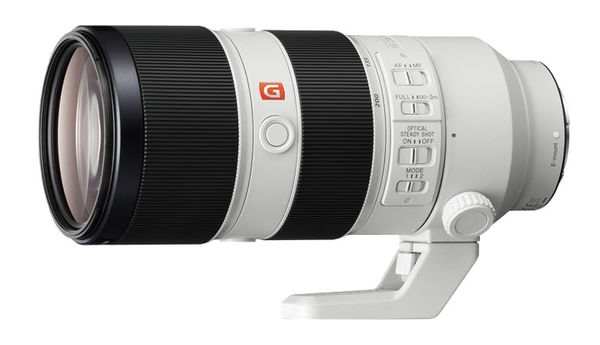
Sets mit Sony SEL 70-200mm f/2.8 GM OSS Sony FE mount
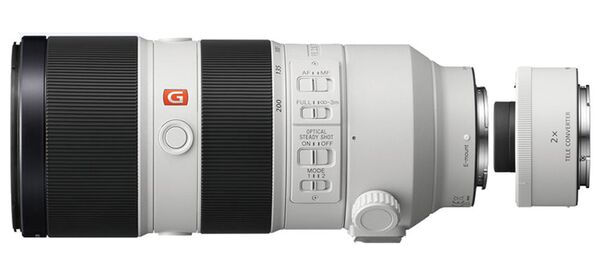
Sony SEL 70-200mm f/2.8 GM OSS + SEL-20TC 2.0x teleconverter Sony FE mount
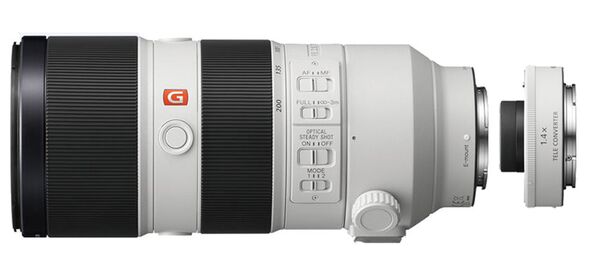
Sony SEL 70-200mm f/2.8 GM OSS + teleconverter SEL-14TC 1.4x Sony FE mount
Meaning of the delivery status
Immediately available
The item is in stock and can be shipped at short notice.
The item is also in stock in our shop in Düsseldorf.
Please note: Despite updating our website regularly, it is possible that an item may be out of stock but shown as available for a short time, especially when orders are high. All information is therefore without guarantee. We will inform you immediately if there is a delay in the expected availability/delivery time. The availability information refers to an order quantity of 1. Availability may vary for higher order quantities.
Delivery time (from-to) working days after receipt of payment
The item is not in stock in our inhouse warehouse and will be ordered from the external warehouse/manufacturer or disributor after you have placed an order. The expected delivery time is listed with the item.
Please note: Despite updating our website regularly, it is possible that an item may be out of stock but shown as available for a short time, especially when orders are high. All information is therefore without guarantee. We will inform you immediately if there is a delay in the expected availability/delivery time. The availability information refers to an order quantity of 1. Availability may vary for higher order quantities.
Item has been ordered
The item has already been ordered from the manufacturer or distributor. The delivery time is usually between 1 week and 2 months. As soon as a more precise delivery time is known, we will publish the details on our website. After placing the order, you will be informed regularly about the delivery time.
Available at a specified date
The item has already been ordered from the manufacturer or distributor. We have been informed of the expected delivery date.
We are happy to order for you
The item is currently not in stock and will be ordered for you from the manufacturer or distributor after you have placed an order. The delivery time is usually between 1 week and 2 months. After placing the order, you will be informed regularly about the delivery time.
Item has been ordered. Delivery time 1-3 months
The item is currently not available. We were not given a delivery time. Experience shows that the expected delivery time is 1-3 months.
Goods have been ordered. Long delivery time expected. Pre-order now and secure your place on the waiting list.
The manufacturer or supplier cannot confirm a date, so we assume a waiting time of 2 to 9 months. You can still order the item and secure your place on the waiting list.
Delivery alarm
You would like to be informed as soon as the item is in stock?
Notification when the product is back in stock No reservation and no place on the waiting listYou want to reserve the product?
Order now, pay later (prepayment) Notification when the product is back in stock Product reservation and fixed place on the waiting list Cancellable at any time free of charge (until delivery)
Often a decision for life - the choice of the right lens
Photography is always a question of focus. Clearly, it is the lens that changes the focus and makes all the difference. And it's always a question of skill, of personal preferences and strengths. Of course, the question of which lens the photographer chooses is also due to the available camera systems - whether he prefers to work with system cameras (CSC) or with single-lens reflex cameras (SLR). Fixed focal lengths have no zoom, here the eye of the photographer is needed, because he must know which situation requires which settings. For this reason they have a particularly good imaging performance with very low distortion, which results in their superiority over other lenses. Fixed focal lengths are suitable for a whole range of subjects, from landscape photos to portraits. All lenses from Lensbaby, for example, are manually adjustable. In the field of fixed focal length lenses there are new high-performance classics, optimized for digital technology, for example from Leica or the lenses from Meyer-Optik-G?rlitz, which have been revived according to original plans and adapted to digital technology. Zoom- and Megazoom lenses are high-performance lenses with a particularly wide focal length range with fast, virtually noiseless autofocus suitable for wide-angle or telephoto tasks. Here Nikon surprises with the world's first ultra-wide-angle lens with image stabilizer, which ensures strong images even in low light. Horizons that bend, and pillars that tip forward for no reason ? every photographer knows these difficulties. To photograph distortion-free is a special challenge with landscapes as with architecture Wide-angle lenses are among the fixed focal length, macro, zoom or fisheye, among them a particularly strong distortion-free lens of Canon. While the zooms and megazooms also cover the telephoto range, pure Telephoto lenses are suitable both as fixed focal lengths and as zooms - especially for wildlife and nature photography. At the top end of the range, lenses from Hasselblad and Leica are worthy of any digital post-processing due to their outstanding quality. Olympus currently has developed the lightest and most compact telephoto (Micro FourThirds mount) lens, while Sigma is the world's first lens with a maximum aperture of 2.8 at a focal length of 500 millimeters. Close to the subject ? small becomes huge ? that is the specific feature of the Macros and its versatile field of use. For this special small world, most lens manufacturers carry lenses, like Canon, Nikon, Sony, Leica or Pentax as well as Tamron, Sigma or Samyang. Fish-eye lenses are being covered by D?rr, Samyang, Pentax, Panasonic, Olympus, Nikon, Sony or Walimex. With fisheye photography, creative results can be achieved and surprising effects can be produced, such as mountains that bend and walls that bow outwards. Tilt-and-shift lenses, these are made by Canon, Nikon, Laowa, Leica, Samyang or Walimex, for example, and help the photographer to correct the perspective of the image, i.e. to compensate for particular distortions, such as falling lines in architecture. "Tilt" means pivoting (of the lens system in relation to the image plane). "Shift", on the other hand, means shifting (for example, the focus area can be shifted while maintaining the same exposure time).

