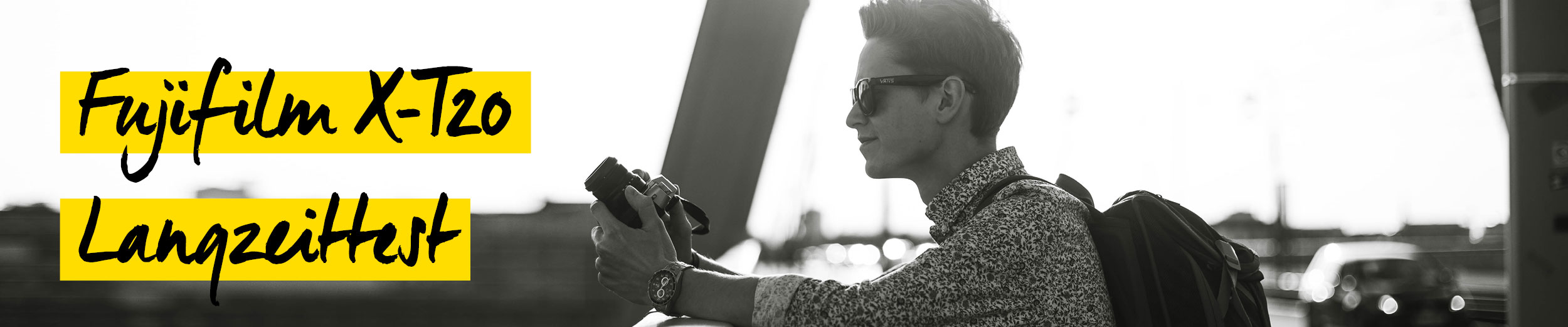
One year system camera - One year with the Fujifilm X-T20
This experience report is about my personal highlights and experiences from a year with the Fujifilm X system. Among other things, I will discuss my selection criteria for buying a new camera system and explain why I decided against the Sony Alpha series. I will show you some of my photos and videos from different areas of photography. The article will answer the question of why I sold my DSLR and how I made the switch to the digital viewfinder.

Why a new system?
Before my time with Fujifilm, I worked with Canon DSLRs for four years. First mainly with the EOS 700D, then later with the Canon EOS 7D. At the time I bought the 7D, it was already several years old, but the functions and high-quality workmanship had convinced me. After two years of intensive use and many kilometers of travel, I was faced with several problems
- I constantly had the feeling that my photos were not really sharp. I'm not sure if it was my way of focusing, the AF of the camera or the lens I was using. The result was often blurry pictures
- The salty air by the sea and my risky use of the DSLR were the reason why the flash wouldn't open and some buttons were broken.
- I have covered many thousands of kilometers with the Canon DSLR. In most cases with two full-frame lenses, filters, triggers and tripods. You probably know how quickly you get to a 13 kg photo backpack. It's actually a miracle that I always managed to get the backpack into my hand luggage on the plane. My problem was the size and the weight. On family vacations, I often had to decide whether I really wanted to carry everything with me or just take photos with my smartphone
- I wanted to concentrate more on video. The Canon EOS 7D didn't give me enough options, including no continuous video autofocus
During all these considerations, I looked around the market to see what alternatives were available.


Information:
Click on the photos to enlarge them. If the sample photos were taken as RAW, you will find the download link under the photo. The image rights remain with the photographer!


The path to the Fujifilm X system:
I read many test reports on the Internet, watched videos and clicked through sample images. The Sony Alpha system was the first one that piqued my interest. I was able to decide between the 6000 (APS-C) and the Alpha 7 series (full frame). I definitely wanted an upgrade to my 7D, but switching to full-frame was too expensive for me. I also wanted something small and compact that would give me more flexibility when traveling. When buying a new camera, don't forget the lens. Full-frame lenses are much bigger, heavier and more expensive than APS-C lenses.

With the mirrorless Sony APS-C cameras I had the choice between three models: A6000, A6300, A6500. It all sounds nice, but what's the difference? This was the question that kept me busy for several weeks. The technical differences are easy to find out. My question was rather: Which one is best for me? What do I really need? Would I rather buy a more expensive camera or invest the money in better lenses? After I had asked a photo dealer to repair my 7D, I happened to come across a brochure for the Fujifilm system, which I hadn't even considered before. There I picked up both the Sony and the Fujifilm to see how the cameras felt in my hand. I knew I had to make a compromise and get away from the massive handling of the DSLR. The Alpha 6000 series has its advantage - for me - in the video functions and in the sensor stabilization (A6500). I found the Fujifilm X-T20 more comfortable to use and it fit better in my hand. I therefore opted for an optimum between photo and video performance - the Fujifilm system. After a weekend of testing, it was clear to me that it would be a camera from the Fujifilm system. What impressed me most during the short test phase was the excellent and fast autofocus for portraits.


The X-T20 or X-T2 ?
Once again I was faced with the decision of whether I should go for the bigger brother or whether the T20 was the better choice for me. I decided on the X-T20 a year ago because of the price/performance ratio. Since I've been working at Foto Koch, I've also worked a lot with the Fujifilm X-T2, so I want to look back at this decision.

The sensor of both cameras is identical, so both cameras should also achieve the same image quality. The advantages of the X-T2 lie less in its technical features and more in its feel and features. The X-T2 has one more adjustment dial than the X-T20. This is convenient when things need to be done quickly. The display of the X-T2 can also be folded sideways, but not completely. Two memory card slots give the photographer the option of writing the photos to two SD cards and thus creating a backup. The handling of the X-T2 is more comfortable for me than that of the T20, as it is larger and fits better in the hand. But that would be another step back for me, further away from my goal and that's why I would probably choose the X-T20 again today. Another advantage of the T2 is the splash-proof body, especially looking back on my salt water experiences. Nevertheless, I don't spare the X-T20 and so far it has survived everything well if you look at it after use. The most critical experience so far was when I was filming while snowboarding and fell in deep snow. The camera and the Lens (XF23 F2) were full of snow! I removed the snow as quickly as possible before it could thaw and neither the camera nor the lens were damaged. The X-T2 is of course the better camera, but every photographer has to decide for themselves whether they need the additional functions and whether they justify the extra cost.

The latest generation: Fujifilm X-T50
Meanwhile, the X-T20 is no longer the latest model in the Fujifilm range, here the X-T50 is the new flagship and relies on 40.2 megapixels, the sensor of the X-T5 and comes with 3 different colors: Anthracite, Silver and Black.
The most important technical details at a glance:
- compact system camera with 40.2 megapixel sensor
- Film simulation dial
- folding LCD monitor with 1.84 million pixels
- ultra-fast exposure times up to 1/180,000 second
- 5-axis image stabilization with up to seven f-stops
- 6.2K video

My area of application for the X-T20
First of all, I want to describe the situations in which I use the X-T20. Not every time I take the camera with me, the whole day should revolve around photography, for example at family celebrations, on (non-photo) vacation or simply when I can't take a large camera with me. In my backpack I have the Fujifilm X-T20 and the small XF 23 F2. This gives me flexibility and allows me to capture moments inconspicuously. If I have a larger project ahead of me and I have the option of using an X-T2, X-H1 or a full-frame camera, then the X-T20 is used as a backup, time-lapse or making-of camera.


My highlights of the X-T20 and the Fujifilm system
Silent shooting
I can take advantage of the benefits of a mirrorless camera, such as silent shooting. This has the advantage that in some situations I don't draw attention to myself and don't disturb anyone or can take more authentic pictures, as no one notices that I have triggered the shutter.
Eye/face autofocus
One criterion for my switch away from the Canon DSLR was the focus for portraits. With the Fujifilm X-T20 I no longer have to worry about this, because the camera automatically focuses on the face and even on the eye if you want. Although this function is not as innovative as the eye autofocus on the current Sony Alpha 7 models, it is a milestone compared to a DSLR. The X-T20 also offers plenty of focus points.
Fujifilm picture looks
The Fujifilm system is known, among other things, for the internal JPG development of the camera. There are several to choose from. From desaturated to black and white, you can find exciting image looks. As a self-confessed RAW photographer, I underestimated this feature at first, but now I occasionally shoot "only" JPGs with the Fujifilm looks. It's simply quicker and still turns out well! You can also send the JPGs directly to your smartphone. That's not possible with RAWs.
Digital viewfinder
A huge change at first, but later a real helper. I find it much easier to take photos with a digital viewfinder, as you can see the finished image in front of you and can therefore better assess the exposure. This is especially great for beginners, as you can learn how to use the manual mode much more quickly, as you can see all the changes immediately and can experiment with them to a certain extent. Although you have to get used to the new viewfinder image for a while at first, you later realize what advantages this digital viewfinder brings with it.
Another practical feature is the button directly on the viewfinder, which allows you to quickly change where the image is to be displayed. You don't have to spend ages searching for this function in the menu. There are three options to choose from: Viewfinder - Display - Automatic with eye sensor.

Selection of high-quality lenses - manual aperture
The Fujifilm lenses cover all the shooting ranges I need. I now use the 23 F2 95 percent of the time, both for photos and video, because it's super compact and exactly my focal length range. I personally really like the feel of the manual aperture ring! However, I don't use it much as it is usually set to F2. For all automatic fans, you can also set the aperture to automatic I would also describe Fujifilm's range as clearly laid out and I mean that in a positive sense, because the X system is in APS-C format and all cameras can be used with all lenses. No permanent distinction between full-frame and APS-C.
Lenses from third-party manufacturers
For all shooting areas for which Fujifilm does not offer a suitable lens, there are manual lenses from third-party manufacturers, such as Zeiss, Samyang, Walimex and others. I have an extreme Wide angle from Samyang which is only a third of the Fujifilm wide angle zoom and is ideal for astrophotography. If you want to use your existing lenses from another system on the new camera, then Fujifilm is the wrong system for you. Sony offers many more options in terms of adaptability.
Advantages of a system camera
Switching to a mirrorless camera system involves some changes. System cameras, like all X cameras in the Fuji system, often have a wider range of functions than SLR cameras. These advantages are particularly noticeable in the selection of focus points and the tracking of moving objects. For example, all settings and elements that can be seen on the display are also shown in the viewfinder on system cameras. Not to forget the compact dimensions and low weight of the X-T20 and the new lens series.
Retro design
Finally, I would like to say something about the design of the X-T20. This is certainly not a purchase criterion for every photographer, but I find the silver body and the retro design very chic. I also have the camera with a Gariz half-bag a release button and a leather wrist strap.
Filming with the Fujifilm X-T20 system camera
A large part of my work is the creation of videos. In August 2017, I completed a large project with the X-T20. I filmed in full HD at 60fps and with continuous autofocus. The camera was mounted on a compact gimbal. The equipment for this video shoot fit completely into a small backpack. Gimbal, camera with 23mm, Video light reflector. The project was realized - except for one scene - with the 23 mm. The biggest advantage when filming is the compact size of the camera. The low weight is very pleasant, especially when moving the camera with the gimbal, and the system is very versatile. Compared to Sony system cameras, I sometimes miss the LOG color profiles, but for many beginners and even advanced users, this function is not relevant.

Video functions of the X-T20
The X-T20 can record 4K videos. I hardly use this feature at the moment, but I think it's important that a current camera offers this function. You can record the sound of an external microphone via the 2.5 mm microphone input. Attention 2.5 mm! Why Fujifilm has not installed a standard 3.5 mm socket here is questionable, but with an inexpensive adapter this is no problem. I recommend a short adapter cable instead of an adapter plug. This protects the input socket! The X-T20 also has a practical aid on board for manual focusing. The focus peaking! This feature is now built into many system cameras and helps with focusing by marking the focal plane with a colored edge highlight (also called edge sharpening). To assess the exposure, zebras can also be displayed in both photo and video mode. These mark areas that are too bright and too dark.


My conclusion on the Fujifilm X-T20
For me, the Fujifilm X-T20 is a great travel camera and suitable for all applications where I want to have a compact and flexible camera with me. The Fujifilm system gives me a large selection of Lens and upgrade options, such as the X-T2 or X-H1. The image quality is first-class and the APS-C sensor is sufficient for many shooting areas. The X-T20 has already surprised me in some cases, be it as the main camera in my video project "Danke Augsburg - Danke Heimat", or as a backup camera with great video quality, so that I am considering using the X-T20 more often as a main camera again.
more sample pictures of the X-T20:
Action photography in Switzerland


Travel photography Djerba



JJ | 08 2018