Sony Alpha 7R V Hands-On - The best autofocus on the market?
We've waited a long time for it and now it's here! The new Sony a7R V comes with an autofocus that works in the dark and always knows where your knees are, a crazy video resolution, a whole three processors and a brand new, unprecedented display technology. Find out what all this is about in this article!


Tech talk: Sony Alpha 7R V
In addition to our review video, we sat down again and talked in detail about the new a7R V and our experiences with the new camera in a livestream. If you read this post early, you might even be able to join us live! :)

 Sony Alpha 7R V
New Body
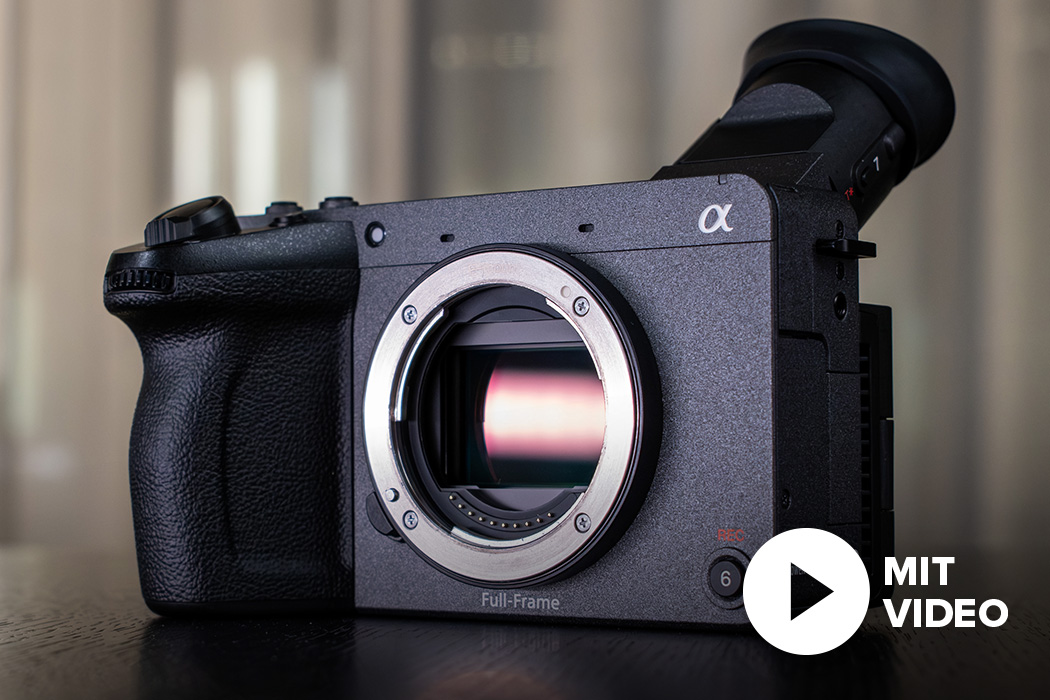
When we held the camera in our hands for the first time, the body looked familiar at first glance. Anyone who has ever worked with an a7 IV, an a7S III or perhaps even an Alpha 1 will feel right at home here.
Here we have the split function or mode dial, the unlabeled setting dial for free assignment with, for example, exposure compensation, full-size HDMI and not just one, but two CF Express Type A hybrid card slots.
Compared to its predecessor, the grip has also become deeper and therefore easier to handle. We'll come back to what the new viewfinder and the new display can do in a moment.
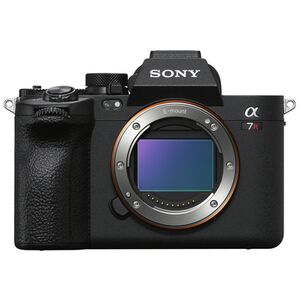
Sony Alpha 7R V (ILCE-7RM5) Housing
- Full frame camera
- 61 MP Exmor R CMOS BSI sensor
- Autofocus with artificial intelligence
- Continuous shooting at 10 fps and full AF / AE tracking
- 8K 25p video recording
- 4K 60p & RAW output via HDMI
- 5-axis image stabilization (IBIS) of up to 8 f-stops
- Dual CFexpress type A hybrid card slot
 Sony Alpha 7R V sensor
Technical innovations of the Sony Alpha 7R V
New 61 megapixel BSI sensor
The new sensor is housed in the new body. Instead of the 61MP sensor of the a7r IV, we have a new 61 megapixel BSI sensor, which therefore offers significantly better noise performance and, above all, better color reproduction.
What is missing here is the stacked structure that we know from the Alpha 1 or the Alpha 9. So if you need a high continuous shooting speed, you should perhaps look at the other two cameras. The Alpha 7r V can only shoot up to 10 fps in a series.
The new sensor has an autofocus coverage of 76%, with a total of 693 points in phase detection. In the 16:9 image format, it then covers 86% of the sensor area. But let's take a closer look at what else the autofocus can do.
Another important thing to mention inside the camera is the new IBIS, which can now correct 8 f-stops and is therefore better than anything else we have ever seen in full-frame format. For comparison: the Alpha 1 or the a7 IV can only correct 5.5 f-stops.
Dual Bionz XR processors
The data is read out and processed by the two Bionz XR processors, which together ensure that the camera can deliver maximum performance. We know the processors from the Alpha 1, for example, where they ensured incredibly fast processing and storage, and here too, with the a7r V, we have a virtually infinite buffer. Although on paper the buffer can "only" hold 88 uncompressed and 184 compressed RAWs at 10 bps continuous shooting, the CFexpress type A cards are fast enough to free up the buffer in good time before it reaches its limit.
In addition to the two Bionz XR processors, there is another processor unit, but we'll come back to that in a moment.
 Sony Alpha 7R V Display
New LCD display & revised electronic viewfinder
On the back of the camera is the clear core feature of this camera. The new 3.2-inch display!
At first glance, you can already see that the new a7R V appears a little thicker than, for example, the Alpha 7 IV or the a7S III. This is due to the new display folding mechanism, as we now have the option of folding the display up and down as well as swiveling it outwards and rotating it there.
But the display is also definitely an upgrade in terms of resolution, brightness and color reproduction, and it has even become 0.2 inches larger.
Away from the one display, towards the other - the new viewfinder: This also looks familiar on paper, with 9.44 million pixels it has almost twice the resolution of the viewfinder of the 7r IV, but offers the same refresh rate of 120fps. This makes it only the third camera from Sony to offer such a high-resolution viewfinder. However, the Alpha 1 has a higher refresh rate of 240fps.
Of course, the new a7rV also has some other cool and important features. And that brings us straight to the autofocus!
 Sony Alpha 7R V autofocus example (screenshot from the camera)
AI-controlled autofocus
The third processing unit, which we briefly mentioned earlier, is entirely responsible for autofocus. This is where artificial intelligence (AI) is used to make the autofocus as accurate and, in particular, as reliable as possible.
Short spoiler: The camera can recognize the head of a bee, the body of a butterfly or even the windscreen of a car, but of course we'll show you that in a moment.
First of all, we need to talk briefly about how the whole thing works: A classic AF with face recognition can recognize a face and accordingly say "the two dots in the upper third are probably the eyes", but is confused if the person turns away, the head is not recognizable, you have a mask on and so on.
What this AI-controlled autofocus does now: It creates a "skeleton" of the entire body (as we know it from the animation sector, for example). The camera recognizes not only the head, but also the eyes, ears, nose, shoulders, hips, knees and legs. I hope we haven't missed any points here. So if there is no eye to be seen, the autofocus still knows that there is a person standing there and can track and focus on them in the image.
So! That's all well and good, but what else can this AI do? You can already guess where this is going: The AI can also recognize this skeleton in insects, i.e. the camera knows what the head of a bee is, it recognizes the body of a butterfly and so onâ¦
Of course, we couldn't try out the AF on every insect, but we were really impressed by what we were able to test.
But there's more, because even vehicles are no problem for the camera. Cars are recognized as such and if you see them at an angle from the front, the headlights are used as a focus point. If you are facing the car from the front, the focus then switches to the windshield. Vehicles naturally also include motorcycles and, in theory, bicycles. At this point, however, the autofocus works best when the bike is completely visible in profile.
For all plane and train spotters, there is of course also the recognition of airplanes and trains (also here with the recognition of the windshields).
Unfortunately, the camera is not yet ready to automatically recognize the subject and switch the subject recognition accordingly. You still have to adjust the scene recognition in the camera menu as usual. However, we recommend using a shortcut button, for example on the Lens. Here you can also choose which modes you want to switch between at the touch of a button, e.g. between vehicle and human.
On the other hand, recognition in dark lighting situations has also been improved. Even at -4 f-stops (the value refers to the tests and the settings used there by Sony - other manufacturers test with different settings, so you have to be careful when comparing the EV values), the camera can deliver full autofocus performance here.
However, we don't want to throw around the term "artificial intelligence" too much, as the recognition usually works perfectly, but other cameras also switch to the body when the face is no longer recognizable.
A very important side note here, however, is that there are no limitations - in other words, the autofocus works with everything it can, in all modes and resolutions. We have to take up the cudgels for Sony here, because this is not a matter of course and Sony has always attached great importance to this in other cameras.
All in all, however, we think it's a good step in the right direction and we look forward to seeing what will be possible in the future with updates or new generations.
 Sony Alpha 7R V
8K video & 4K 60p ProRes RAW output
The camera also leaves only a few wishes unfulfilled in the video area. However, it must be clearly stated beforehand that video is of course not the main target group here.
Thanks to the high-resolution sensor and the two fast processors, video recordings in up to 8K at 24 or even 25 fps are possible here. 8K 30 fps is missing at this point - according to Sony, this was not possible because the sensor readout is too slow. This would require an Alpha 1 with the stacked sensor, which can simply be read out faster.
In 4K, up to 60 fps are possible here at 4:2:2 10 bit, which can also be output via HDMI in ProRes Raw.
Slow motion recordings can also be made here without any problems, but only at up to 120 fps in FullHD. If you need more at this point, you should take a look at the a7S III, as 4K 120p and Full HD with 240p are possible there.
Of course, we also have popular features such as Breathing Compensation, Active& image stabilization and recording in S-LOG3 and S-Cinetone.
Incidentally, all recording modes are recorded here with full sensor readout and those filming in Super35 mode can benefit from 6.2k downsampling at up to 30 fps in 4k.
However, there is not much more to say at this point in the video area, so let's see what other features are on board here.
5 GhZ Wifi & 10 Gbps LAN
The Alpha 7R series from Sony is all about resolution, which is why we also have the popular pixel shift feature here , with which we can create up to 240 megapixel images. This creates 16 images, with the sensor being shifted slightly between each image using IBIS. Incidentally, an update for the Imaging Edge desktop software is also coming here, so that miscalculations can be intelligently avoided.
When it comes to connectivity, we also have a few updates here. Two 5GhZ Wifi modules have been installed for faster wireless tethering. On the other hand, you can also tether with 10 Gbps wired via a USB-C to LAN adapter.
 Sony Alpha 7R V
Conclusion
But let's come to a conclusion: even though the resolution has remained the same from generation four to five, unlike expected, Sony has packed the camera with some very important and future-oriented features.
With the 7rV, the manufacturer is laying the foundations for the future of autofocus technology. Precisely because the resolution is so high, the focus has to be right. 8K video has also been added, as well as small important updates to the display, the body with the new white balance sensor and connectivity.