Camera Basics #11 - Flash / continuous light and the properties of different light sources
Photography has many facets. Working with artificial light is only one of them. In this article, we want to show you the differences between the various light sources and explain the properties of the devices.
We are looking forward to your feedback on this article! Just send us an email to content@fotokoch.de
The first flash - how did it work?
We can't let you into artificial light photography without some background on its history. In the beginning, flash was produced by burning flash powder or magnesium. Later, the first flash bulbs were developed that could only be used once, but achieved a high light output. Since 1933, there has been a synchronized flash from the Leitz company, and in 1935 the first flash found its way into a camera.
The beginning of flash photography was very dangerous: if the mixing ratio between the different fuels was not right, undesirable side effects occurred. In this era, there were many injuries, fires and even fatal incidents.

Basics of light
After the story we come to the basics! Because if you understand the basics, it will be easier to apply your knowledge later. Of course we'll try not to annoy you too much with too much technology.
Kelvin / Light Color
The color of light is measured in Kelvin. For flashes it corresponds to around 5600 Kelvin. With continuous lights there is the option of a Bi Color light ; this can be adjusted in Kelvin value and can thus provide a colder or warmer lighting mood. In flash photography, this can only be done by using color foils to adjust the value.
Guide number
Describes the intensity / strength of the flash light. It is essentially used to calculate the exposure time. However, it can also be measured in Ws (watt seconds) or watts.
Flash synchronization
Describes the automatic synchronization of the shutter with the firing time of the flash. There are different methods to determine the flash synchronization. Different shutters and different camera brands ensure different shutter speeds. This must be taken into account to prevent a rolling shutter. A rolling shutter is when the shutter is visible in the image and it is darkened. Usually this limit is 1/180 to 1/250.
If you want to go below this sync time you have to resort to short sync / high-speed sync (HSS). This makes shorter exposure times conceivable. With HSS, exposure times of up to 1/8000 are possible.
Note for cameras with an electronic shutter: Switch your camera to mechanical shutter when flashing, because currently (2023) the sensor and the technology is not able to be read out fast enough. This causes sensor banding, which is visible as bars running horizontally in the image.
Light adds up
If you use multiple flashes, the amount of light adds up. Of course, this also applies to continuous lights. Three clip-on flashes have three times the amount of light of one clip-on flash.
Light fall-off at a distance
If you use an artificial light source, the distance of the light source to the subject plays a significant role in the intensity of this. If the flash or light is close to the subject/model, the light cone cast will be much more intense than if you were to place the unit further away. The distance also plays a role in the softness of the light
Camera flash
The flash in the camera is usually a simple method to illuminate a person. Unfortunately, the light is usually not very nice, it blinds the model and gives a Polaroid-like look. With a white business card, the light can also be redirected to the ceiling to expose the image a bit more indirectly.
Clip-on flash
Mobile, flexible and space-saving. These are the characteristics of a clip-on flash. It shows its strengths when it comes to indirectly illuminating a scene. However, its weaknesses must also be taken into account: Low light output and high battery consumption.
Especially the latter can be quite annoying if you shoot a lot at full power, then many AA batteries go through the flash unit. A clip-on flash is now also available with replaceable batteries and USB interfaces for firmware updates. But the problem of light output remains. If you try to flash the sun out of your face with a clip-on flash, you will quickly be disappointed because the power is too low.
Therefore, this does not work very well. If a softbox is also used, power is also lost due to each diffuser cloth used before the exit. If you use a softbox, then you should set the zoom to a wide angle in order to diffuse the light better into the softbox.
A pop-up flash does not have its own connection for softboxes / light shapers.

Godox TT685II flash unit
- Guide number (1/1 output, 200mm): GN ~60(mISO100)
- Zoom range: 20 to 200mm
- Offers many different modes like manual, TTL with HHS9, FEC, FEB, rear-curtain-sync mode and more
- With 2.4 Ghz Wireless X-System
- Flash duration:1/300s 1/20000s
Zoom function for clip-on flashes
As with the focal length, the clip-on flash has a "focal length" (zoom), the zoom tells in which scattering angle the light comes out of the flash. This essentially plays a role when using on-camera. If you work unleashed, the factor for the distance to the object or the illumination of the softbox plays a role.
If you choose a zoom that does not correspond 1:1 to the focal length, the light cone of the clip-on flash does not match the angle of view of the image. Of course, you can use this as a stylistic device. With the zoom, it is also possible to improve the range that the pop-up flash covers.
HSS or no HSS?
As described before, without HSS it is not possible to use the flash at shorter exposure times. Especially outdoors it is difficult to work without HSS, because the light that prevails outside often does not allow slow exposure times of 1/200. Of course it is possible by using a ND filter. However, this can make it difficult to focus perfectly. Stick-on flashes without HSS are usually cheaper and are often purchased as the first flash. TTL flashes often also offer the HSS function, as they build on each other.
TTL / iTTL
We don't want to go too deep into the technology here, but nevertheless we will go into what TTL actually is. If you use TTL, you let the flash measure through a pre-flash how much light is needed to illuminate the subject and pass this information to the camera. This happens in different ways: Radio or via the pins / multi-interface of your hot shoe.
Because of the feature, care must be taken when using the brand's hot shoe. Without this feature, no major communication exchange happens between the camera and the flash, which means you can still use any flash via the hot shoe's center contact.
Special design of the clip-on flash
The conventional clip-on flash is rather angular. But this is changing in recent years. With the round deflector disk, the light cone is different than it is with a square flash. The round flash also offers a lot of possibilities for different accessories.
Instead of a diffuser lens or diffuser cap, other attachments can be put on very conveniently, like a honeycomb or wing doors. Sure, a lot of this also works with the conventional clip-on flash, but the reflection is not as natural as that of the round model.
Which softbox for a pop-up flash
The output of the pop-up flash is usually sufficient to adequately illuminate a softbox up to 60cm. The zoom of the pop-up flash also plays a role here. Anything larger than the 60cm will result in a significant loss of power.
Advantages of clip-on flashes
- Compact size
- Acceptable performance for premises
- Wide range of color foils at reasonable prices
- Versatile combinations
Disadvantages of clip-on flashes
- High battery consumption
- Low performance outdoor

Godox Witstro AD200Pro
- Portable flash unit
- powerful, lightweight and compact
- interchangeable flash head
- integrated Godox 2.4G wireless sync system
- TTL function support
- 200Ws
Mobile flash / Porti
The use of modern mobile flash systems offers a lot of potential, because with a powerful flash system you can actively work against the sun and soften or flash away disturbing shadows. Mobile flashes start at 100Ws and end at about 1200Ws (exceptions prove the rule). The more power the flashes have, the bigger the generator and the battery that supplies the flash with power.
This should be taken into account if you have to transport the equipment to the location. Flash units are usually supplied with a Bowens connection for softboxes or offer the option of integrating an adapter. Some brands also use a completely separate connection, which is why you should pay attention to the connection when purchasing a light shaper.
One brand with a very good price-performance ratio is Godox. The range offers a wide variety of different flashes & lighting technology.
Advantages of mobile flashes
- Can be used outdoors
- No annoying cable
- Partially available as hybrid devices
- Light shaper connection often built in
Disadvantages of a mobile flash unit
- Partly high weight
- Partly no modeling light built in
Studio flash
The dream of your own studio, surely many have, you too? Flash units in the studio range are mostly corded to ensure short recharging times and continuous use. Certainly, there are now also many hybrid devices on the market, with which you get both a studio flash and a mobile flash unit.
Studio flash units must be well matched to the local conditions. Too much power in a small space is not necessarily useful. As with mobile flash units, studio flashes are equipped with a port for light shapers.
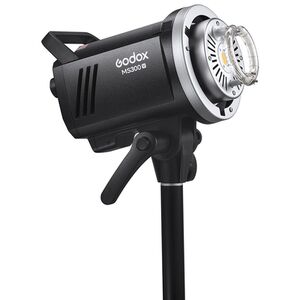
Godox MS300V
- daylight 5600K flash head
- user-friendly functions
- Guide number of 58
- Modeling light - 10W LED
- Color temperature - 5600 ±200k
- Led display
- Flash duration - 1 / 2000s - 1 / 800s
- Bowens mount
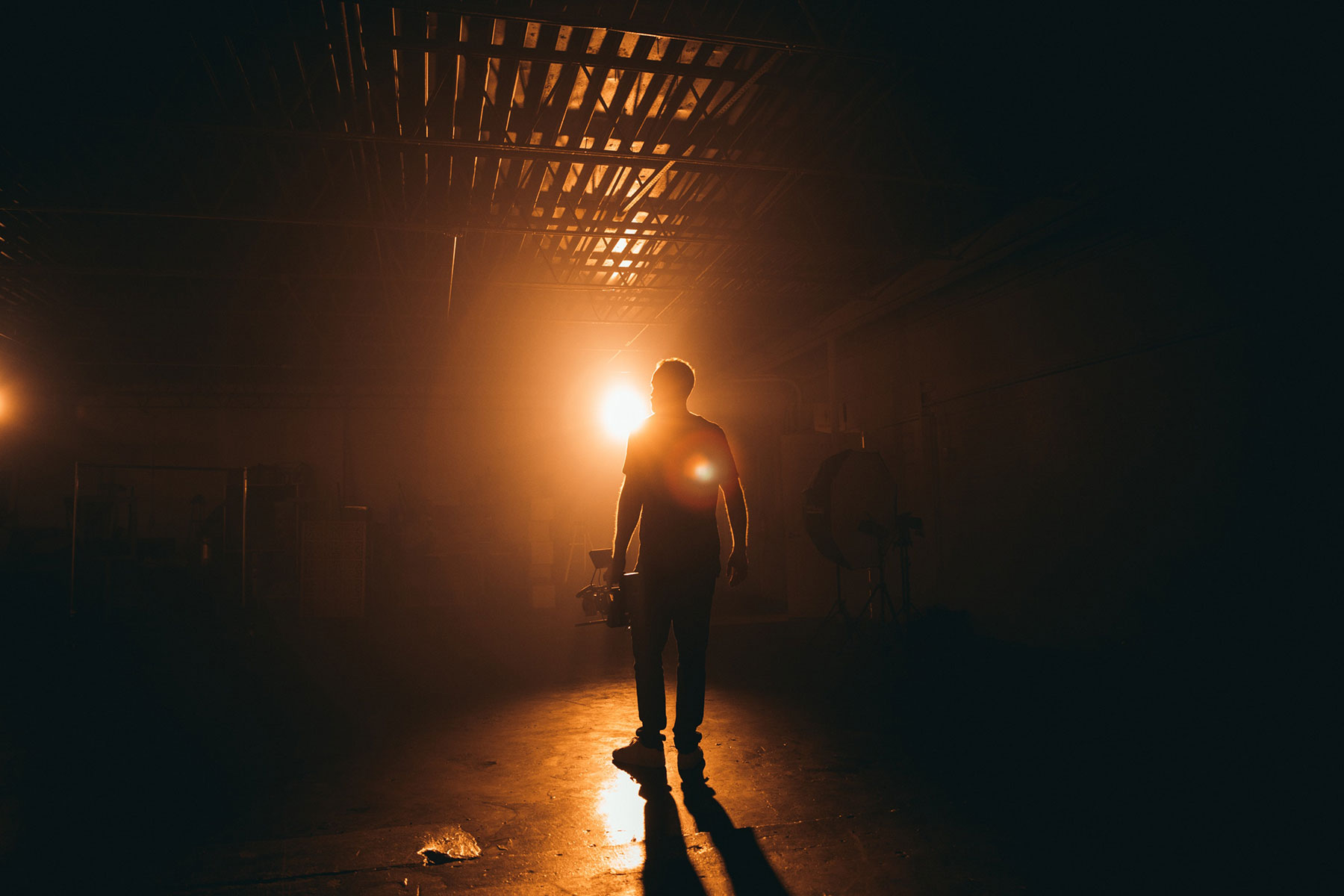
Continuous light
Continuous light is enjoying a resurgence in popularity. Since it is also suitable for video production, many are now choosing to buy a continuous light. They come in many different shapes and designs.
A big disadvantage is the operation outdoor or onlocation without power supply. Since a continuous light emits light continuously, it consumes a correspondingly large amount of power. This comes from the wall socket, V-mount batteries, Sony NP-FXX or a power station.
Thus, continuous light can be perfectly used for jobs that consist of video production & photography, because consistent light quality is provided. A continuous light also ensures, especially for continuous shooting, that the model can move freely and the photographer has light available throughout, without having to wait for the flash to recharge.
Types of continuous light
We have already mentioned that there are different types of continuous light. We would like to list some of them below:
- Studio light with light shaper mount
- Area lights
- Tubelights
- Light sticks
- Ring light
- Area light round
What is unleashed flash?
When the flash is on the camera, it is not unleashed, but only when it moves away from the center of the camera. In the past this was done via a cable, but now it is also done via radio and over long distances. If you like to shoot outdoors, you should definitely give this a try.

A small task for you:
Try using the flash indirectly by bouncing it off a wall and use the flash off-center of your camera with a wireless trigger.
Show us your pictures on Instagram and/or Facebook and tag us @fotokochde! We look forward to seeing your results!
Thanks for reading this article. If you're interested in more photography basics, then check out the other camera basics
Get to know your camera ? Discover the fun of photography
You bought a camera and are taking your first steps in photography? With the automatic mode you miss a lot of potential! Photography is only really fun when you understand your camera and know exactly which settings you need to get the photo you want. Learn the importance of the functions and ignite your enthusiasm for photography!
Go to all camera basics



Last viewed articles