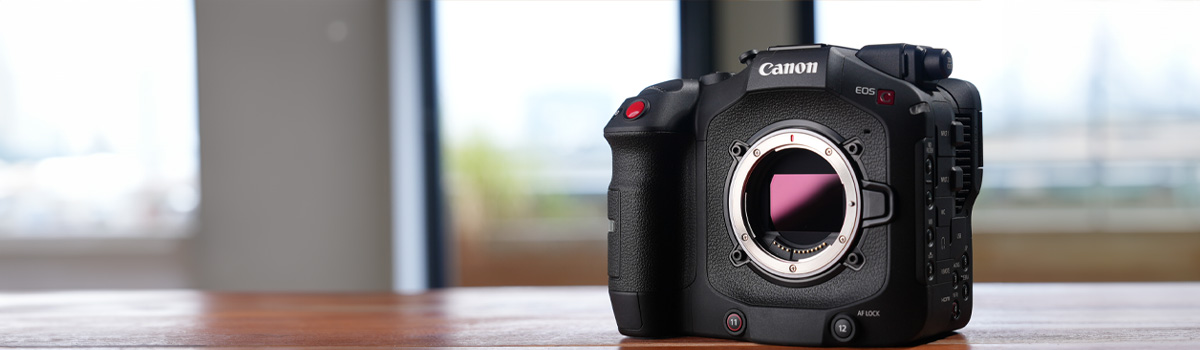
Canon EOS C80 - a new highlight in the world of cinema?
After Canon's announcement of the EOS C400 a few months ago, probably nobody thought that something new would come along. So this really took us by surprise! Let's take a look at the new Canon EOS C80 together!

Body
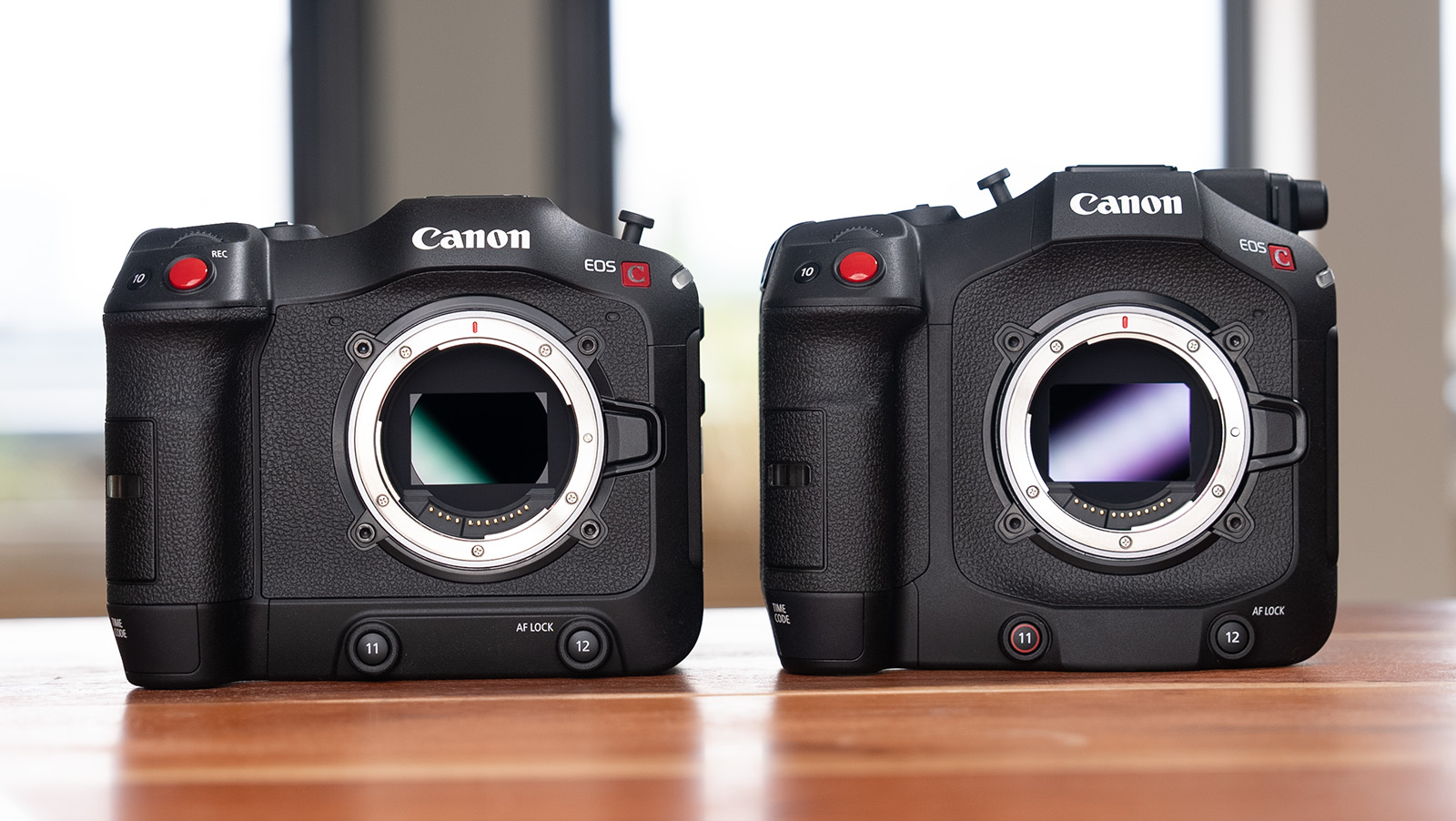
Let's start with the Body and see what differences and similarities we find to the C70: The first thing we notice is that the C80 is a little taller. There is now also a bulge on the top right-hand side for the new SDI port, which the predecessor did not have.

Canon EOS C80 Camcorder
- 6K BSI full-frame sensor
- Dual Pixel CMOS AF II
- Triple Base ISO
- 12 Bit Cinema RAW Light
- 4:2:2 10 Bit Recording
Apart from a small design adjustment to the lower buttons, the camera has otherwise remained largely identical. Well, except for the massive sensor in the middle, which we will look at in detail later. What is interesting here is that the screws around the bayonet have also remained the same.
As is now usual with Canon, we also have an RF mount here. What is special, however, is that the new PL - RF mount adapter also fits. This means that existing PL Cinema Lens can be used. However, we must add a marginal note here: Even though this adapter theoretically fits a C70, it is not officially supported by Canon, at least not at the moment.
Nothing else has changed on the port side. We still have full-size HDMI A, headphones, LANC, USB and 2 mini XLR ports for audio. Large XLRs would have been desirable, but we forgive Canon for this, as the camera would otherwise have been noticeably larger. If you need large XLR ports, you can use the Tascam audio adapter.
The two buttons for the built-in ND filter are of course also there. Here we are pleased to mention that the ND filter now switches noticeably faster, which makes working with it more pleasant compared to the C70. Unfortunately, it is not an electronic ND and we are therefore limited to the fixed levels 2, 4, 6 - and in extended mode 8 and 10.

The back of the camera, on the other hand, has been completely rethought and there are many changes:
-
The LCD display has retained the resolution, but is now much brighter, which is very pleasant in outdoor use, so without a viewfinder.
-
[There is now a locking mechanism below the audio controls so that the display is clamped in place and no longer sticks out as strangely as it did on the C70.
-
The placement of buttons 7 / 8 and the joystick has been changed. In the same breath, the joystick has also become larger and easier to grip - fortunately.
-
And last but not least: next to the battery compartment there is a Lan connection , which was completely missing on the C70, just like the SDI port. The camera can now be used properly in the network, but we'll come back to that at the end.
On the handle side, unlike on the C400, we have the flap for the 2 UHS II cards for simultaneous or continuous shooting. The manufacturer has therefore dispensed with mixing the media, i.e. CF Express B and SD, and streamlined it somewhat, which also leads to a restriction, but is identical to the C70 in terms of design.
Oh yes, and the BNC timecode connection is of course still there.
There was also something to upgrade from above: The hotshoe is now the multi-function shoe with contacts and has been moved back a little. A mounting point for the new top handle has been added in the front area so that it sits firmly and leaves the shoe free.
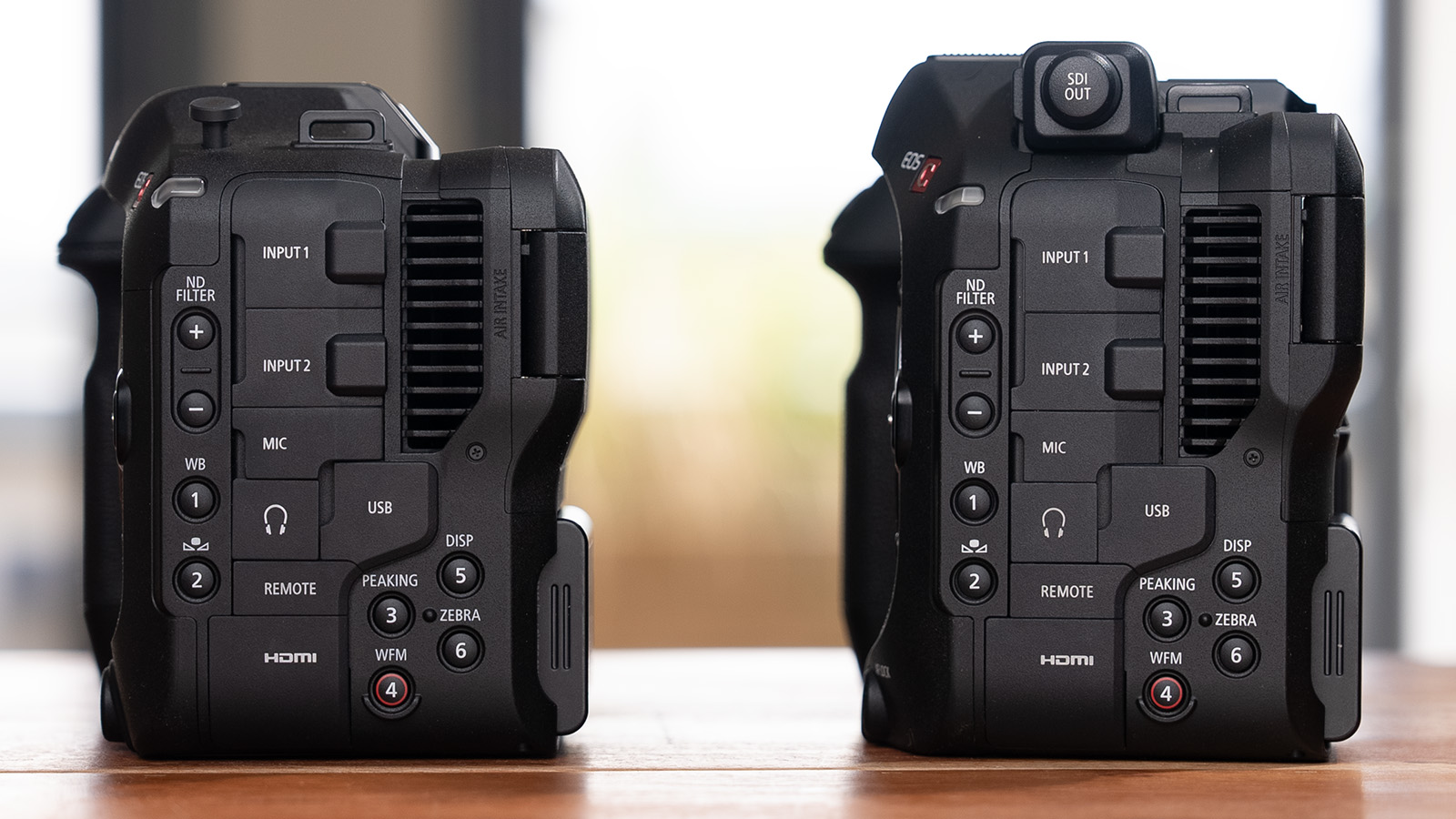 Comparison of the connections: Canon EOS C70 (left) and C80 (right)
 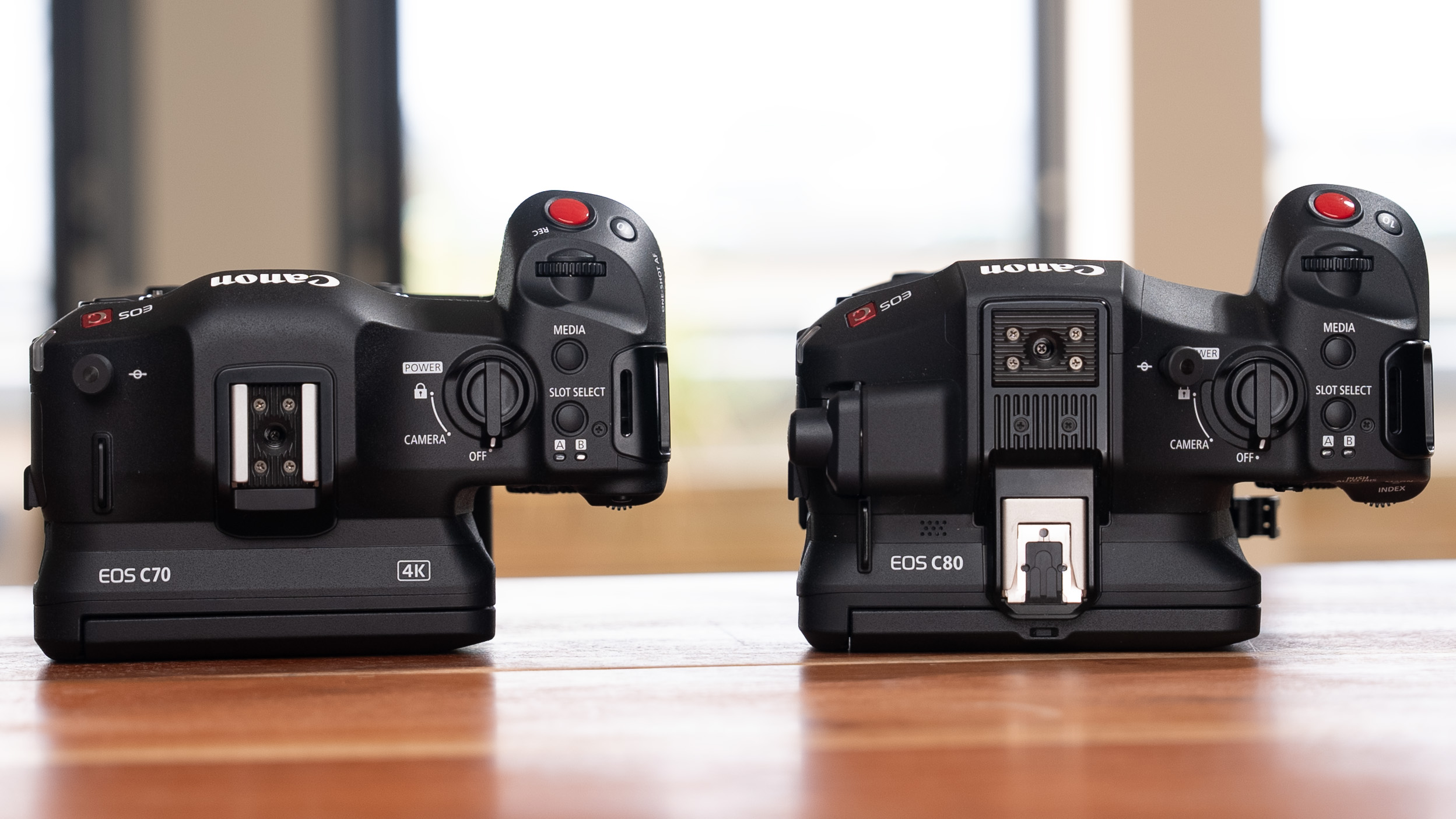 Shoe comparison: : Canon EOS C70 (left) and C80 (right)
 Top Handle
But let's also talk briefly about the handle. We really like the fact that it now fits well and that the new design feels secure. However, the solution for the Smart Shoe is not quite as well thought out and you need the optional OC E4A cable to turn the top shoe into a multi-functional shoe. On the other hand, the microphone holder has been designed to be detachable so that it cannot bend in the pocket. What we would still miss here would be controls such as zoom or at least a record button, as is possible with other camcorders. So there are slight deductions in the B grade. However, as people in the target groups are more likely to use an XLR microphone, this is okay for us for the time being. In the next version, however, we would like to see controls and a longer base that uses the multi-functional shoe directly and transmits the signal in the handle. Thank you Canon.
Finally, it should be mentioned here that a ¼" connection has been added on the underside, which has also extended the shape of the Body slightly towards the front, but now makes it possible to screw a tripod plate twice.
So you can really say that Canon has carried out an all-round refurbishment here and placed the functions above the classic form, which makes the camera increasingly boxy without becoming as large as the C400. What we would like to mention, however, is the weight, because with all the new features the C80 is almost 110g heavier than the C70.
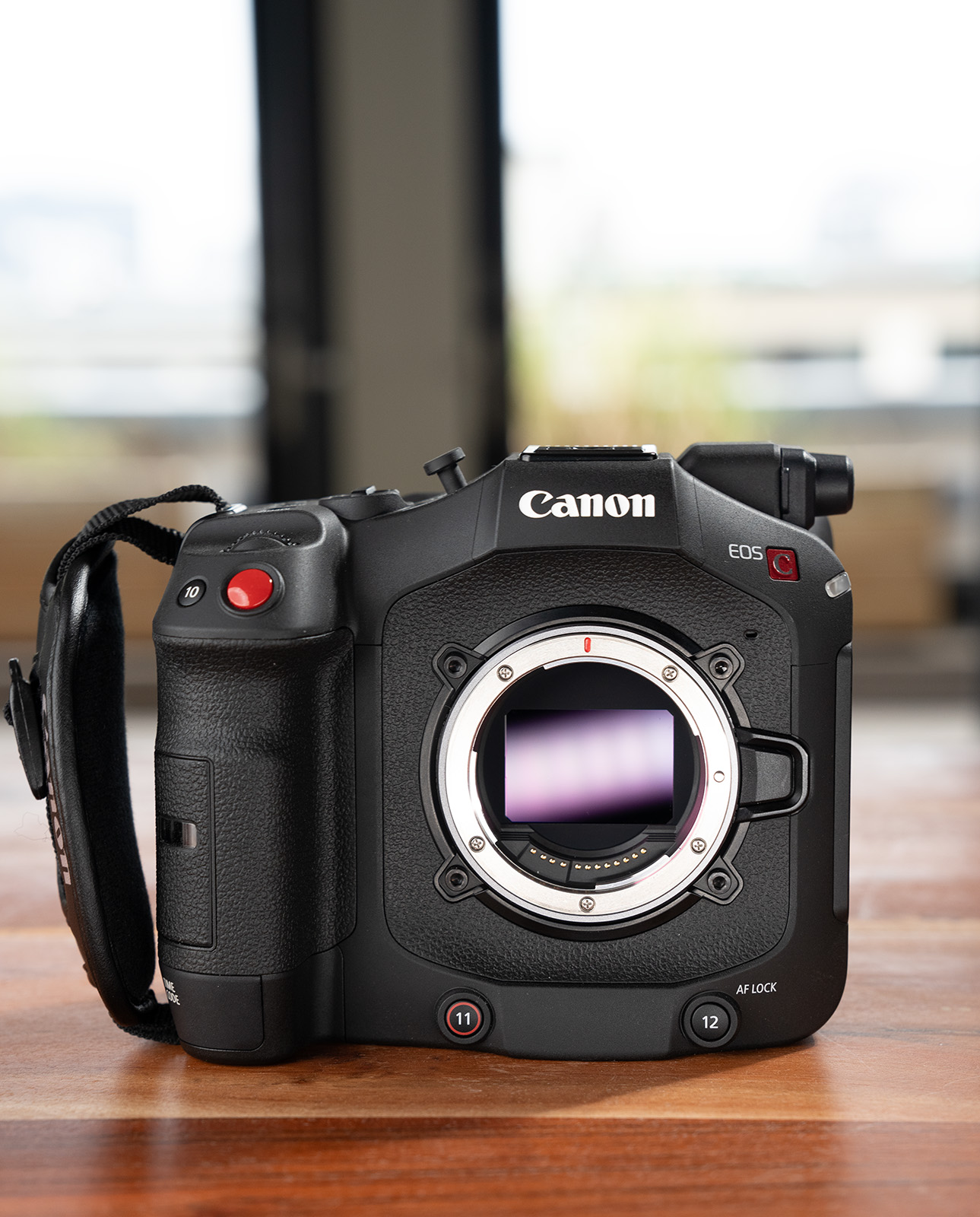
Sensor
But enough about the exterior. Let's focus on the most important and biggest change: the new BSI stacked full frame sensor.
We already know this 26.7MP sensor from the C400 and it brings enormous performance to the small body: 6K raw video, triple base ISO, 16 stops of dynamic range and much more! However, there are a few functions with a different scope to the C400, so let's take a look at the camera together and highlight these in more detail.
Stabilization
But before we go into the exact resolutions, frame rates and bits, it should be mentioned that this sensor is not mechanically stabilized. There is only the option of adding a digital image stabilizer, which of course crops the image depending on its strength. However, since many Canon Lens have a built-in image stabilizer, this is absolutely fine. Especially as the weight has been kept such that the set can also be balanced on a gimbal.
Resolution +& Frame Rates
Having a large sensor is all well and good, but it's no good if you don't use it properly. Here, however, we are more than satisfied. If you want to record in 12bit Cinema Raw Light LT, you can do this in 6K with 30p in full frame and 4.3K with up to 60p in S35 mode internally on a V90 UHS II card.
The C400 even allows 6K with 60p and the option of using Raw Light in HQ or ST; however, this requires the CF Express B slot, which is not available here.
What has also been inherited are the new recording formats XF-HEVC S and XF-AVC S with the MP4 container. Don't worry, MXF is of course still on board with XF-AVC. This is particularly exciting, as the new naming scheme simply brings much more structure to a professional workflow.
However, if you now want to record more than 60p in 4K, you can do this in a Long GOP 4:2:2 10bit recording with 120p as H.264 or AVC recording, in 2K even 180p are possible.
Please note here, however, that when recording in S35 mode, a crop of 6% is added if you go over 100p and also that recording in 6K is not possible with S35.
For recording in All Intra, a maximum resolution of 4K in 4:2:2 10bit with 60p is possible. This is cleanly oversampled by the 6K sensor and therefore super detailed without debayering artefacts; as long as no stabilizer is used. If this is activated, the sensor is slightly cropped and no longer correctly oversampled. If the strong stabilizer is used, aliasing artefacts may become visible.
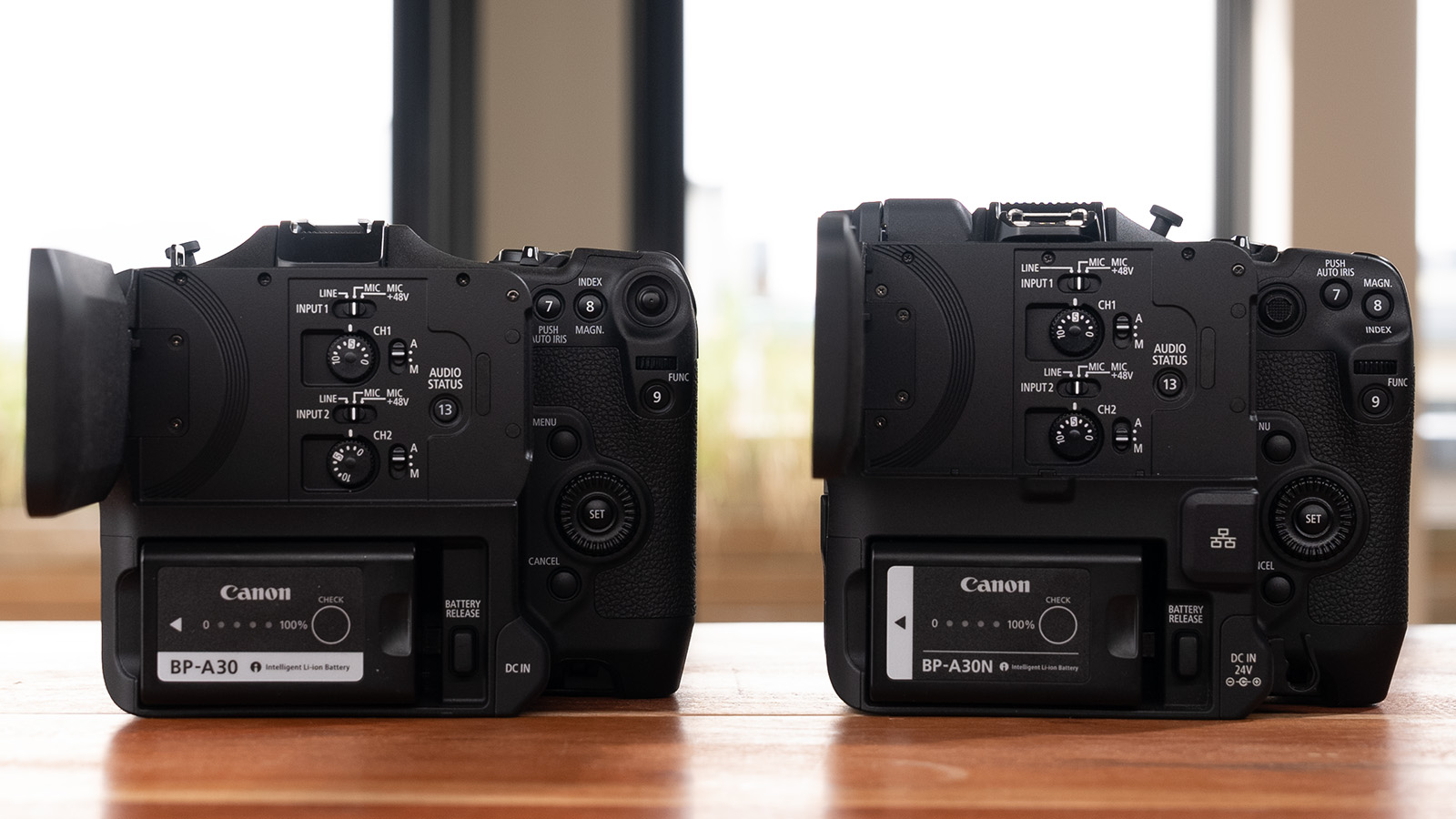
Battery +& restrictions
When using the old BP30 battery, i.e. without the N suffix, there is a small restriction: the multifunctional shoe cannot be used with the old battery, which then requires a BP-30N or BP-60N.
Rolling shutter
Unfortunately, we are currently unable to provide any concrete figures on the rolling shutter, as we do not have them and have no way of reading them out directly. In our test, it is improved compared to the C70 at the same settings, which is hardly surprising with the stacked sensor.
3x Base ISO
The base ISO is where things get exciting. Just as with the C400, we now have 3 values, which are slightly different depending on the gamma,
In CLOG 2, 3 and Raw, these are ISO 800, 3200 and 12800. There are then deviations in the various 709 profiles:
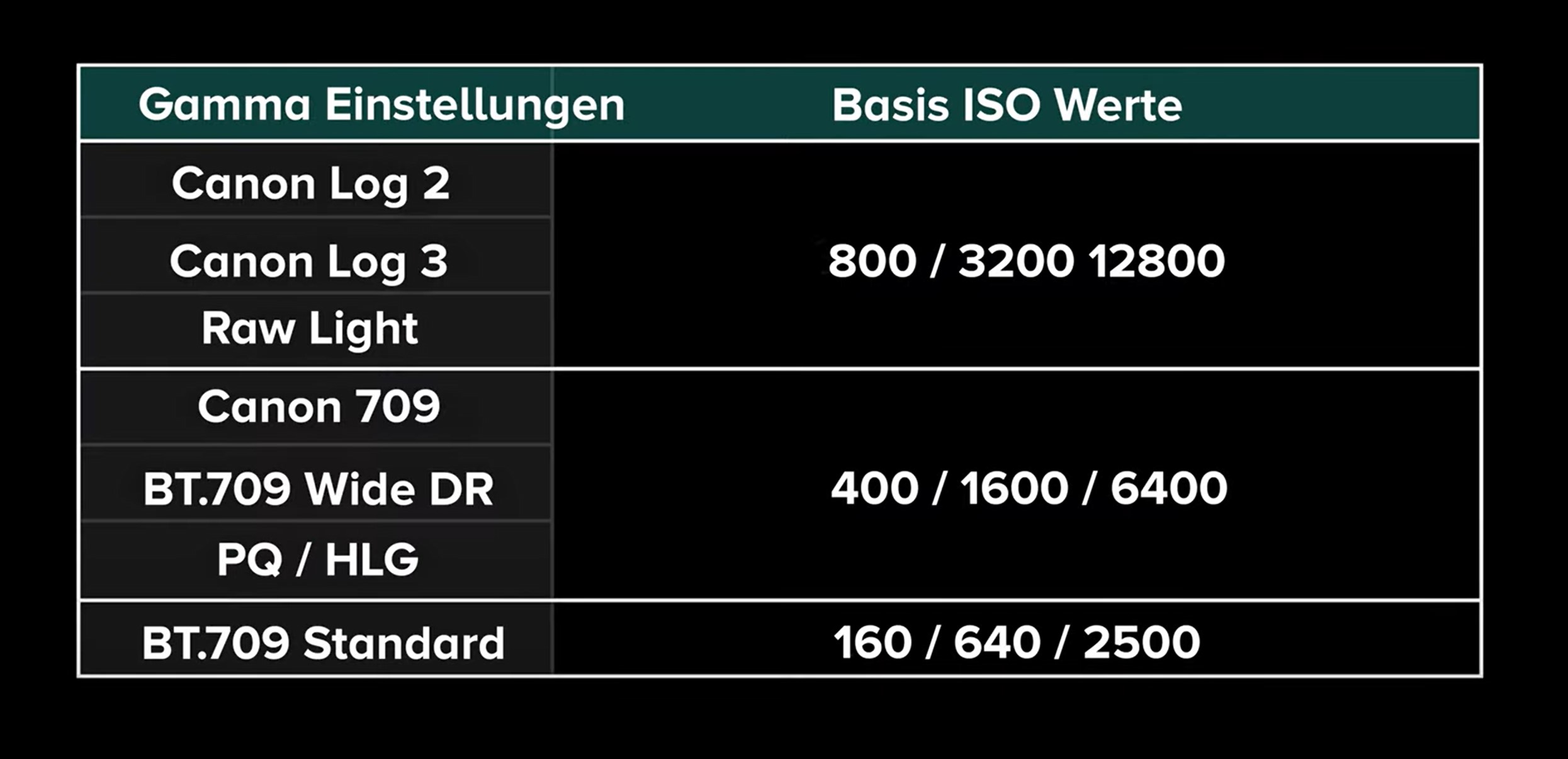
This is damn impressive and super helpful if you have a step between 800 and 12800. Because if you look at a raw clip of the 3 bases, they look almost identical.
You can then either switch manually in the menu or let it run automatically. However, it would be nice if the change of bases would start a little earlier to get an even more noise-free image in auto mode. A custom rule would also be very desirable for the future.
Apart from that, however, we find the performance extremely good and have no reservations about recommending the camera for low light situations.
Gamma +& DR
As we have come to expect from Canon, the C80 offers a huge selection of gamma and color spaces from Canon Log 2 and 3 to various 709 and HLG profiles. Each of the profiles can then be adjusted in the camera according to your own wishes in order to set subtleties such as noise reduction or sharpness.
If you are looking for a good middle ground without a lot of post-processing time, you should try the 709 Wide DR, which provides a good balance.
But while we're on the subject of dynamic range: According to the manufacturer, we got 16 stops here, which is minimally less than the 16+ of the C70. This is due to the sensor design and the lack of dual gain output, but in practice we find these differences so minimal that we would have no problems matching these cameras in terms of dynamic range and definitely prefer the better readout speeds that we get from the stacked sensor.
Autofocus
The fact that only manual lenses are used in the film world is a statement that is now only half true. Of course, large productions still rely on focus pullers, but as a one-man band with many unpredictable events such as in a documentary, a good autofocus is now simply worth its weight in gold, as you can concentrate on other aspects.
In the C80 we now have the new Dual Pixel CMOS AF II, which offers an improved human tracking function. The function for animals has also been added, although this is currently only officially available for dogs and cats. We hope that this selection for nature and documentary filmmakers will be expanded in the future.
Fields of application
The C80 is ideal for documentary filmmakers thanks to the autofocus just discussed, as well as the enormous image quality and long battery life. But also the possibility of RAW recording opens the door for many independent filmmakers who shoot short films and do not want to make any compromises.
However, the new LAN connection and WLAN chip, as well as SDI, have now added another major area: Broadcasting. Thanks to the XC protocol, the camera can easily be fed into an external camera control unit and can be controlled completely remotely. But also IP Direct Streaming with MPEG 2-TS in a resolution of Full HD with simultaneous recording in up to 4K on the SD card.
For a higher resolution, the 12G SDI connection and a corresponding mixer such as the one from Blackmagic must be used. For VR users, the camera is also compatible with the RF 5.2mm L and allows the data to be managed via the EOS VR Utility without stitching.
Last but not least, thanks to the frame-by-frame metadata, the files can also be used wonderfully in Unreal Engine or in Adobe After Effects VFX work.
Conclusion
The C80 really is a feature-packed camera.
It has many of the functions and strengths of the C400, as the two cameras share the same sensor. So if you've been itching to buy this camera, you should consider whether a C80 might not be enough.
For all those who currently have a C70 and want the full-frame format, they can easily upgrade or expand the camera range and then use the C70 as a B cam. Well, at least as long as you have the necessary change. With an RRP of 5899€, the camera is not exactly cheap, but the price is a good 2700€ less than a C400 and that with the many functions that have been adopted.