Guide to ND filters - How to find the right ND filter?
If you are new to photography or videography, you may be confused by the different terms for light reduction and what an ND filter (neutral density filter) is used for.

What does a gray filter do?
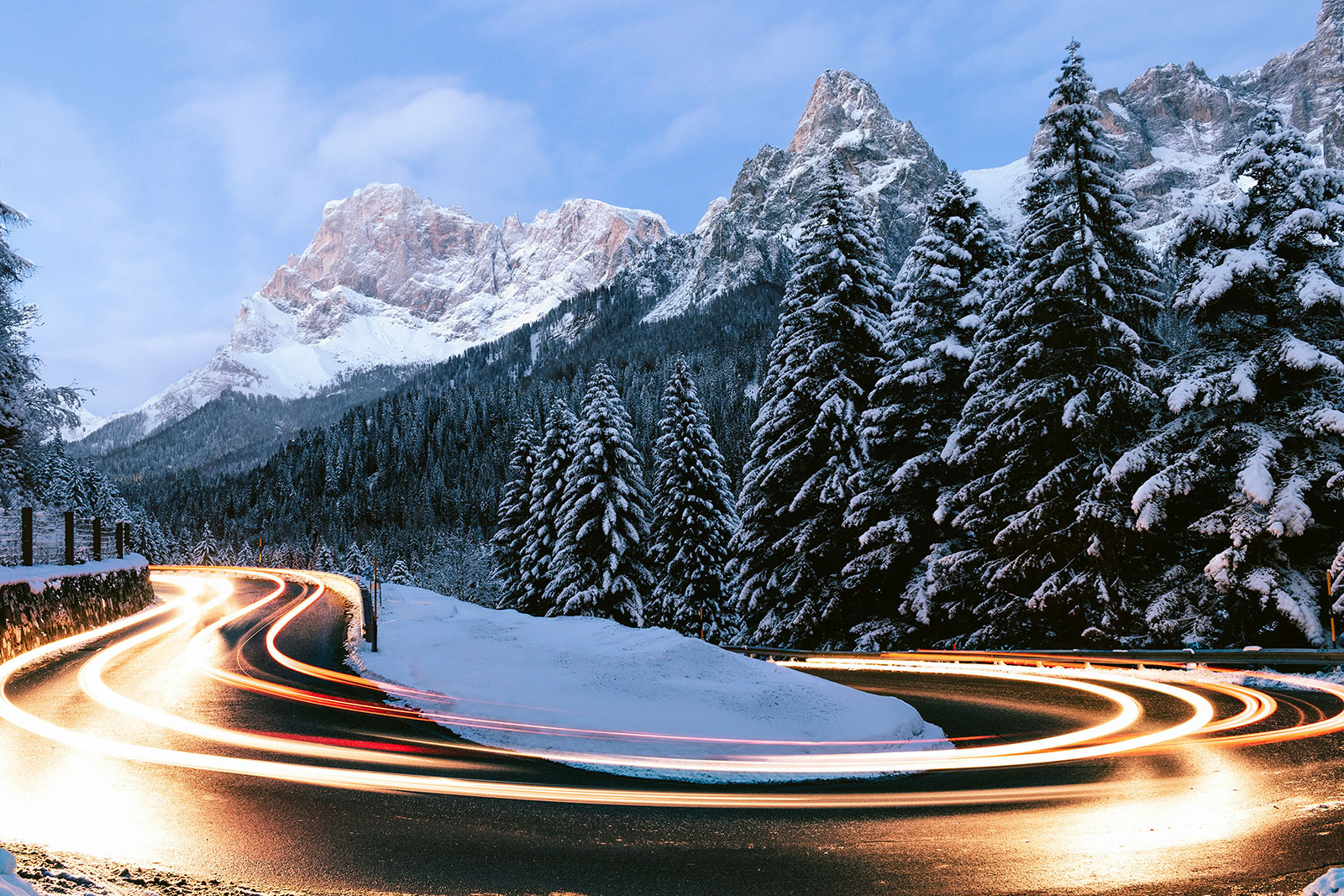
An ND filter (also known as a gray filter) reduces the amount of light entering your camera. For example, you can achieve a slow shutter speed on a very bright day with a wide-open aperture. An ND filter therefore has a direct influence on the exposure triangle: aperture, shutter speed and ISO.
The larger the number on the ND filter, the greater the reduction in light that passes through the ND filter. With gray filters, the light reduction is measured in ND value or stops.
The differentiation between the terms neutral density (ND) and stops (exposure levels) originated historically, with the term neutral density coming from physics and stops being a simpler concept from photography for controlling exposure.
Application examples for ND filters
Long exposure during the day:
- An ND filter makes it possible to extend exposure times in order to softly depict movements such as rivers of water, clouds or crowds of people without overexposing the image.
- Example: With an ND1000 (10 stops), an exposure time of 1/60 second can be extended to 16 seconds.
Open aperture in bright light:
- ND filters make it possible to shoot with a wide open aperture (e.g. f/1.4) even in bright sunlight in order to achieve a shallow depth of field effect.
Exposure times for video recordings:
- Anyone filming is bound to certain exposure times in order to obtain video material that is as cinematic as possible, but the exposure time cannot be adjusted, which means that if you want to film with an open aperture, the image is quickly overexposed. This is where an ND filter helps.
ND filters and their light reduction
In order to compare the values and the light transmission, we list all the common methods here.
| ND-Wert | Stops | Lichtdurchlässigkeit (%) | Shutter speed Extension factor |
|---|---|---|---|
| ND2 | 1 stop | 50% | x2 |
| ND4 | 2 stops | 25% | x4 |
| ND8 | 3 stops | 12,5% | x8 |
| ND16 | 4 stops | 6,25% | x16 |
| ND32 | 5 stops | 3,125% | x32 |
| ND64 | 6 stops | 1,563% | x64 |
| ND1000 | 10 stops | 0,1% | x1000 |

What types of ND filter mounts are there?
You can buy an ND filter in different mounting versions, which one is right for you also depends on your application.
ND screw-in filters
The classic screw-in filters are tried and tested; these screw-in filters can be screwed onto many lenses and offer a secure hold. However, especially with telephoto and wide-angle lenses, the filters are sometimes impossible to mount, in which case a rectangular filter or a drop-in filter is used.
Magnetic gray filter
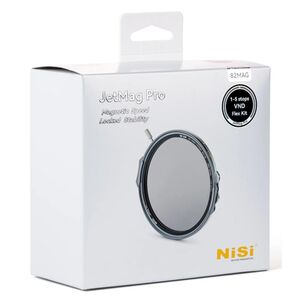
Magnetic filters are becoming increasingly popular, instead of having to fix the filter every time, the filter can be mounted and removed quickly and effectively thanks to the magnets. This is particularly interesting for you if you often have to change filters at short intervals.
Magnetic ND filters are also available in different versions as variable ND filters.
Rectangular filter
A rectangular filter can be attached to many lenses with an appropriate frame. The use of rectangular filters is particularly useful with wide-angle lenses, as they have no problem with the curvature of the front glass element. However, the Lens must still have a filter ring. Rectangular filters are also particularly suitable for the use of gray gradient filters, as the horizon line of the gradient can be easily shifted.
Drop-in / insertion filter / backside filter
A drop-in filter or a filter for the back of a lens is always used when, for example, there is no filter thread; with telephoto lenses, you can insert a filter into a slot, which then has the same effect as a normal filter.

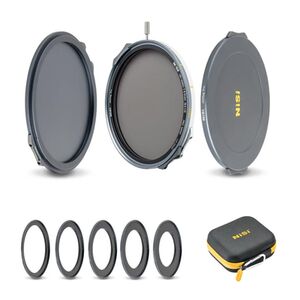
H+Y REVORING ND3-ND1000 and CPL filter 67-82 mm
- ND3-1000
- Gray filter + polarizing filter in one
- Built-in dynamic step-down ring
Variants of gray filters
After the different mounting types of gray filters, we will now go into the different versions of the filters.
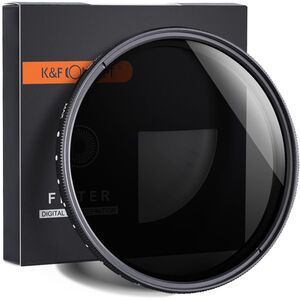
Variable ND filters
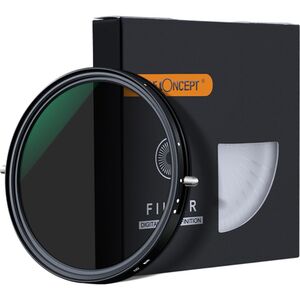
A variable gray filter is actually two polarizing filters that rotate in opposite directions to each other. These variable ND filters are a cost-effective way to save many individual ND filters with one ND filter, but cheap ND filters often have a problem: the formation of an X across the width of the image.
Single gray filters
Single gray filters have the advantage that they are easier to combine and add together to achieve sufficient darkening for a solar eclipse, for example. They also do not cause X formation as the filters are made individually from glass. In professional video shoots, these filters are used in a 4x5.65 format in matte boxes.
Gray gradient filters
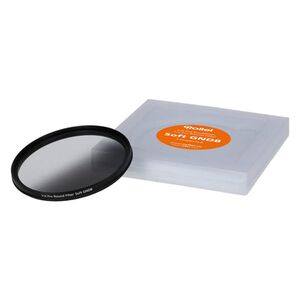
These are the filters for landscape photographers! Many landscape photographers swear by this type of filter as they can be adjusted using the horizon line. This allows the ground and sky to be correctly exposed, creating an HDR look. You can also take a long exposure with drawn clouds.
Electronic ND filter - in the camera
Functions such as ND filters built into the camera are exciting for videographers. OM System, for example, offers these with some camera models, some of which even enable a gray gradient filter.
Clip-in filter in front of the sensor
For some camera models, there are also filters that can be mounted in front of the sensor, which is particularly practical if you have to change lenses frequently and work in a wide variety of locations.
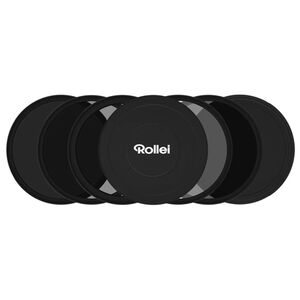
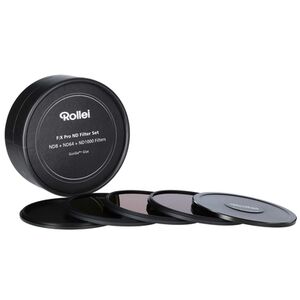
Rollei F:X Pro Magnetic Round Filter MK II Gray Filter Set 82mm
- comprehensive gray filter set with CPL, ND8, ND64, ND1000 and magnetic base ring
- magnetic: no screws or jammed round filter threads
- Filter types printed on the outside of the filter ring
- including practical, magnetic caps for easy and safe transportation
Why are the price differences so great?
The cost of an ND filter varies greatly for a number of reasons, including the coating, the color fidelity and the strength of the neutral density. The main reason is actually the color fidelity, especially cheaper ND filters tend to produce a color cast. This generally decreases with increasing prices, and some manufacturers also have an extra product designation for this, which identifies their filters as color-fast.
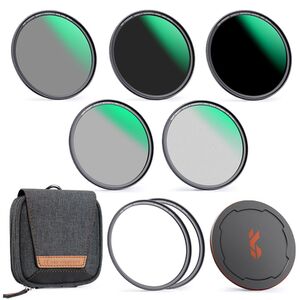
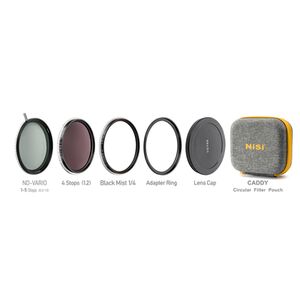
K+F Concept Magnetic Kit CPL / ND8 / ND64 / ND1000 / 1/8 Black Mist 82 mm
- consisting of gray, polarizing and effect filter
- Magnetic system
- multi-coated
- waterproof, oil-resistant, scratch-resistant
- filter bag included
The kit consists of:
- 1x polarizing filter (CPL)
- 1x ND8 filter
- 1x ND64 filter
- 1x ND1000 filter
- 1x 1/8 Black Mist Filter
- 2x Magnetic adapter rings
- 1x filter bag
- 1x filter protection cap

Which ND filter strengths do I need?
It is always difficult to give a general answer to this question, because the right ND filter depends on the lighting situation you are working in. As a rule, it always makes sense to have a set consisting of the most common ND filters with you. The typical ND filter strengths for various purposes are listed below.
ND2 to ND8 (1-3 stops):
-
Perfect for slightly cloudy days or interiors with lots of light.
-
Use: Reduction of slight overexposure with open aperture (e.g. portraits with shallow depth of field).
-
Effect: Minimally longer exposure times or larger aperture opening possible.
ND16 to ND64 (4-6 stops):
-
Suitable for bright sunny days or strong light sources.
-
Use:
-
Long exposures during the day, e.g. slightly blurred movement of water.
-
Reduction of light at medium to large apertures (e.g. f/2.8) for creative effects.
-
-
Effect: Smoothing of water, motion blur on people or clouds.
ND100 to ND500 (7-9 stops):
-
Ideal for very bright light conditions, e.g. midday sun.
-
Use:
-
Long exposures in daylight with significant motion blur.
-
Shooting with an open aperture in extremely bright surroundings (e.g. beach or snow shots).
-
-
Effect: Soft flowing water movement, distant crowds become invisible.
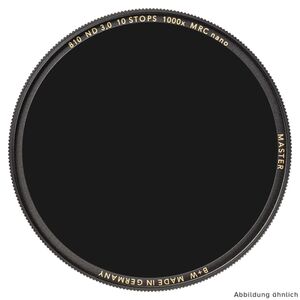
ND1000 (10 stops):
-
Classic filter for extreme long exposures in daylight.
-
Use:
-
Photographing waterfalls, coastal landscapes, cityscapes with "empty streets".
-
Smoothing of water surfaces and intensive capturing of movement.
-
-
Effect: Movements disappear, extremely smooth or "ghostly" images.
Variable ND-Filter (ND2-ND1000):
-
Flexible all-rounder for changing light conditions.
-
Use:
-
Ideal for videography to adjust exposure and frame rate.
-
Shooting in different situations without changing filters.
-
-
Effect: Adaptable light reduction without a fixed filter change.









Notes on orientation:
-
Landscape photography: Mostly ND64 to ND1000 for long exposures and smoothing of water/clouds.
-
Portrait photography: ND2 to ND16 to work with a wide-open aperture in daylight.
-
Videography: Variable ND filters to precisely control the exposure during recording.
-
Extreme conditions (e.g. glaring light): ND1000 or higher.
Conclusion
ND filters are a very good tool for many applications, with gray filters you get a look with long exposures that you don't get as a normal viewer. For videographers, an ND filter is a constant companion and is probably also one of the accessories of which one likes to have several sizes and strengths in one's luggage.