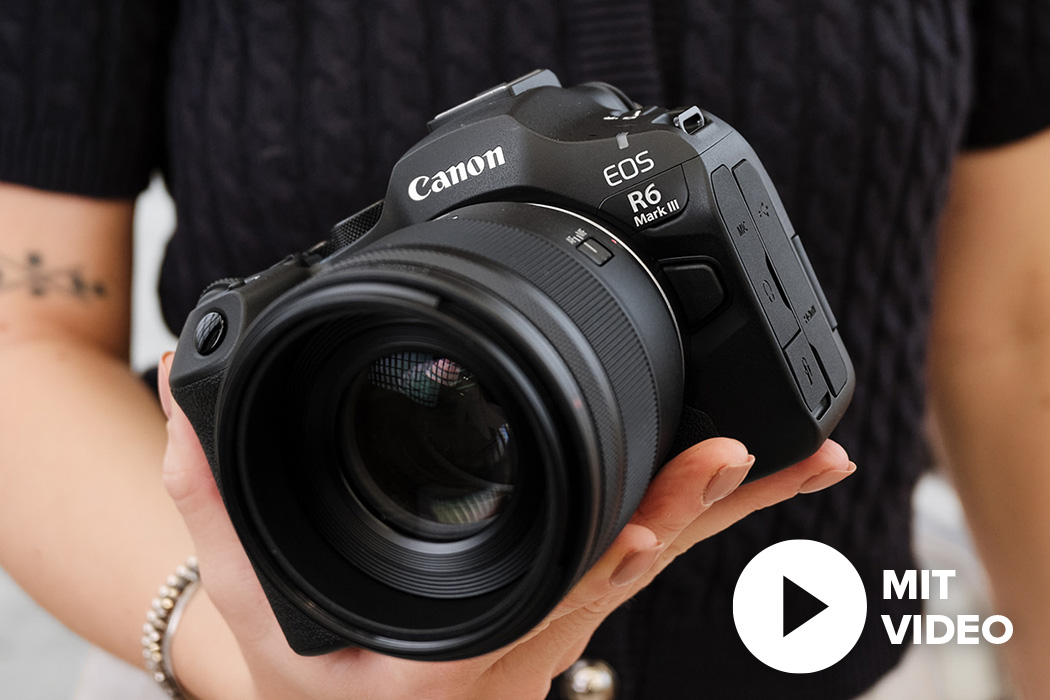
Hands on Canon EOS R1 - The number one for sports?
Today is a big day for Canon fans and all those who might want to become one. After years of hope, patience and perhaps uncertainty, Canon is presenting two new flagship cameras: The EOS R1 and the R5 II.
We were able to spend a little time with both cameras and show you what makes the new R1 so special in this blog post with video. You can find our detailed review of the R5 II here.
But let's get to the number one first. The new R1 doesn't carry this number for nothing, because it is by far Canon's most powerful camera. It is not a direct replacement for the R3, but rather a level above it, is aimed primarily at sports photographers and thus offers the long-awaited replacement for the Canon 1DX, which has always been a popular choice.
With the R1, Canon wants to meet the high demands of sports photography, as there were still some unresolved issues after the presentation of the R3 at the end of 2021. Even though the R3 is undoubtedly an impressive and powerful camera, it unfortunately doesn't seem to be the perfect solution for sports photography. Let's take a closer look at what the new R1 does differently here.

1. Body and design
With the new EOS R1, Canon has revised and improved pretty much everything. This starts with the body design. Even if the body and especially the handling of the R3 were satisfactory overall, there were a few shortcomings that Canon has now worked on. Although the R3 feels good in the hand, it can be a little slippery from time to time. This has now been significantly improved with a much more prominent structure on the R1. The camera really feels extremely good in the hand.
Fortunately, Canon has adopted almost exactly the same operating concept as the R3 in the new R1 and only made minor changes based on user feedback. A few function buttons are now easier to reach and less likely to be operated accidentally.
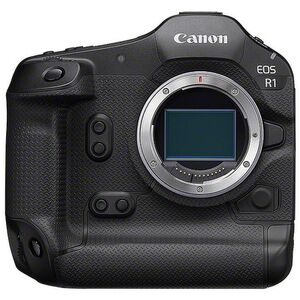
Canon EOS R1 Body
- 24.2 megapixel back illuminated stacked sensor
- CMOS full-frame sensor
- Continuous shooting with up to 40 fps
- 6K RAW video up to 60p
- DIGIC Accelerator
- Eye Control AF of the next generation
- 0.64 inch OLED electronic color viewfinder


1.1 Viewfinder and eye tracking
The really massive viewfinder (EVF) is what immediately catches the eye when you look at the back of the camera. With 9.44 million pixels it not only has a higher resolution, but also an improved magnification. The numerous sensors in the viewfinder, which are responsible for eye tracking, need all that space.
We already know eye tracking from the EOS R3; now it is also on board the R1 - and also the R5 II. Eye tracking makes it possible to control the autofocus point directly with your own eye in the viewfinder. Compared to the R3, however, Canon has significantly revised and further developed this feature.
As a result, eye tracking is now not only even faster and more reliable, but after refining the calibration in the menu, it also works perfectly with glasses - and even with sunglasses. Of course, the viewfinder is also blackout-free and supports a refresh rate of 120 frames per second.

1. 2 Memory cards and image transfer
One aspect that bothered many professionals about the R3 was the memory card slots. Although a hybrid storage system is important for many photographers, it is also a hindrance for many professionals. Two CFexpress cards can now be used in the R1.
Image transfer has also been improved. The Ethernet port now offers faster data transfer and the WIFI chip has also been upgraded to WIFI 6E. In addition, the camera can also automatically switch from Ethernet to WIFI if one of the two is no longer available and also automatically switch between different existing access points.
1. 3 Sensor and speed
Now we come to the core of the camera: the sensor. With the R1, Canon continues to rely on an effective resolution of 24 megapixels, but has developed a completely new sensor especially for this camera. This is a back-illuminated stacked CMOS sensor with Dual Pixel AF. This not only sounds pretty good, but in combination with the DIGIC X processor and the DIGIC Accelerator, it can also do a lot and enables faster and more precise autofocus, a higher continuous shooting rate and also a reduced rolling shutter.
This means that the EOS R1 can now take up to 40 images per second, which may not sound like much on paper, but is certainly sufficient in practice.
What Canon has also improved in the new R1 is the exposure metering. It is now much finer, which means that even small subjects are measured more precisely and the exposure can be adjusted accordingly.

2. Computational photography
There is good news for all those for whom the 24 megapixels are perhaps a little too little from time to time, as the new processors enable some smart AI-supported features:
2.1 Upscaling
One of these functions is upscaling. With this function, selected images from the memory card can be scaled up to four times the resolution directly in the camera. This may not sound like a very good compromise at first because it sounds artificial, but in the end it actually produces a sharper image.
If you want to change the aspect ratio of the image again afterwards, the resolution lost in the process can be easily compensated for by the aforementioned upscaling. The finished image is then saved as a JPEG in the camera and can be shared immediately. This is extremely exciting, especially for sports photography.
2.2 AI noise reduction
AI-supported noise reduction, as we know it from various image editing programs, is also on board with the new R1. The amount of detail and sharpness returned by the noise reduction is really impressive! So if you have accidentally set the ISO value a little too high, you have the option of saving the image directly in the camera.

3. Autofocus
What has also become much smarter in the new R1 is the autofocus system. Canon has already significantly improved the autofocus at the sensor level. The new sensor offers so-called cross-type autofocus, in which the autofocus not only scans the image for vertical lines, but also uses a pixel rotated by 90 degrees to also recognize horizontal lines. This makes the focus more precise and faster in detection.

In addition to speed, the most important thing is of course where the focus should be - and this is where the combination of the DIGIC X processor and the new Accelerator comes into play again.
In addition to eye tracking in the viewfinder, there are two other important features for autofocus:
The first is the ability to register specific people in the camera, to set an automatic priority on multiple people. But probably the most exciting improvement to autofocus is the new Action Priority.
3.1 Action Priority
If Action Priority is activated, we can tell the camera exactly which sport is being photographed in order to utilize the full intelligence of the autofocus.
For example, if the player with the ball is in focus during a basketball game when Action Priority is switched on, the camera recognizes the basketball and can also track it. However, it not only recognizes the ball, but also the player who is currently in possession of the ball.
Accordingly, it also recognizes when the ball is played and switches the focus to the new player in possession of the ball. Action Priority is currently available for soccer, basketball and volleyball. However, we hope that Canon will add a few more sports here.

4. Video
Of course, Canon has not neglected the topic of video in the new EOS R1. Recording in 4K at up to 120fps and 4K with 6K oversampling at up to 60fps is no problem at all! If you really want to get everything out of the sensor, you can also record 6K with up to 60fps in RAW internally.
Of course, Canon's LOG profiles are also on board, with which the camera can also be used very well alongside cinema cameras.
There is also another great feature: Dual Shooting. If this function is activated, JPEGs can also be recorded during video recording - and in series! In addition to sports documentation, this is also particularly interesting for portrait and fashion photography. You can find out exactly how this works in practice in our review of the new Canon EOS R5 II.

5. Conclusion
It was worth the wait! The new Canon EOS R1 is a real flagship, especially for sports photography, which is currently being used at the Olympic Games and has already been put through its paces by selected sports photographers during the European Football Championship. So it remains exciting to see what changes will be made before the camera is released towards the end of the year.
Many of the features discussed here have also found their way into the new Canon EOS R5 II, which we have of course also taken a closer look at. You should also be sure to check out our detailed, exclusive live talk on the two new models: